
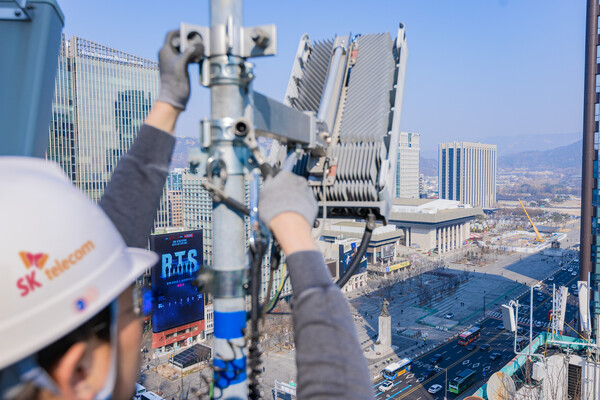
Ahead of BTS' live concert at Seoul's Gwanghwamun Square, the telecommunications industry is focusing its efforts on preparing for a surge in traffic. It is moving beyond expanding facilities to responses using new network technologies. The event is expected to become a stage for technical competition among the three telecom operators, including "autonomous network" technology that optimises networks based on artificial intelligence (AI).
According to the industry on March 18, SK Telecom, KT and LG Uplus have simultaneously begun preparing measures such as expanding network capacity around the Gwanghwamun area and strengthening real-time monitoring systems. To prepare for crowds expected to reach several hundred thousand, they have deployed additional mobile base stations and temporary repeaters and expanded the capacity of existing base stations in advance. On the day of the event, they will also operate an intensive control system linking their situation rooms and the site.
◆ A stage for technology competition among the three telecom operators... AI-based network technology in focus
The event is expected to serve not only as a K-pop stage but also as a venue where telecom operators show off next-generation technologies. The three operators have put intelligent network technologies front and centre, going beyond simply increasing facilities to analysing traffic flows in real time and responding immediately. In particular, autonomous network technology is expected to face a full-fledged test at this event.
SKT will apply for the first time at the site its in-house AI-based network operations system, A-One, at this event. SKT explained that A-One, which incorporates autonomous network technology, can predict network issues in advance and respond in real time during the event. After the event, it will support analysis of traffic flows and communications operation information so it can be used for future communications measures.
An SKT official explained, "Previously, we had to use several systems separately, but A-One integrates them and can respond quickly," adding, "It is a system that helps detect communications disruptions quickly and resolve them more swiftly."
On the day of the concert, SKT plans to monitor traffic in real time with A-One while responding immediately to increases in the number of users, changes in communications quality and equipment abnormalities. Hong Seon-gi (홍선기), head of SKT's Seoul metropolitan network, said, "We will make thorough preparations so that we can provide stable communications services through an autonomous network even in an ultra-high-density traffic environment."
KT will apply its AI-based automatic traffic control solution W-SDN (Wireless Software Defined Network). It is a step to prepare for a traffic surge from social media uploads and live broadcasts and to secure stable communications quality.
SDN monitors network traffic in real time and detects and analyses signs of base station overload in advance, then controls it automatically within 1 minute. KT said it supports stable network operations even at large concerts or events through measures such as precise equal distribution of frequencies and base station output control.
LG Uplus will also apply autonomous network technology in preparation for the event. Ahead of the event, LG Uplus preconfigured mobile communications cells around the Gwanghwamun area. On the day of the event it will conduct real-time monitoring, and if traffic concentrates in a specific cell, it will automatically adjust operating settings such as base station output or connection retention time to distribute traffic.
◆ AI adoption in telecom infrastructure accelerates... also used for disaster response
BTS' Gwanghwamun concert is cited as a test bed to gauge how effective AI-based network technologies are in a real environment. If communications quality can be kept stable in ultra-high-density situations, the technologies could be used in future large events and disaster response. An industry official said, "There is no better stage than this to confirm AI-based communications technologies such as autonomous networks," adding, "Telecom operators will also be able to advance solutions in the future based on data obtained from this concert."
In particular, the industry sees AI becoming a new core element of communications network operations. In situations like this concert where data traffic surges in a specific area, there are limits to relying only on direct human response. An analysis is emerging that the industry is moving beyond an era of expanding facilities into an era where AI-based operational capabilities determine competitiveness.
A telecom company official said, "Now communications networks will become an AI competition, not a facilities competition," adding, "From the perspective of resource投入 such as manpower and deployment costs, the trend of integrating AI technologies into networks will accelerate further."
 Jin-ho Lee
jhlee26@d-today.co.kr
Jin-ho Lee
jhlee26@d-today.co.kr