
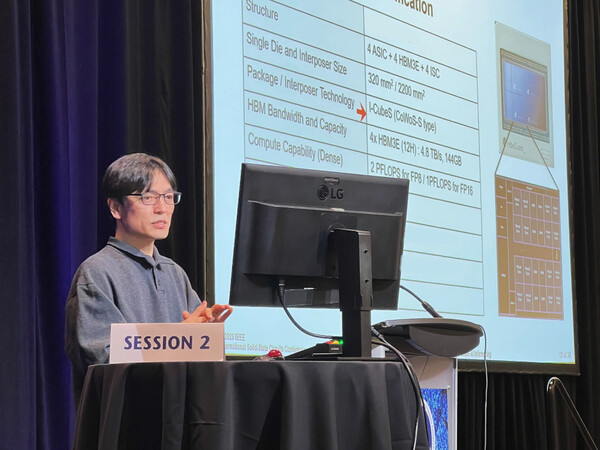
AI chip company Rebellion unveiled its second-generation product, Rebel Quad, at a semiconductor conference. Rebellion said on Feb. 19 it presented a paper on the Rebel Quad architecture and conducted a real-time demonstration at the 2026 International Solid-State Circuits Conference (ISSCC) held in the United States. ISSCC is the world’s most prestigious semiconductor design conference and is known as the “Semiconductor Olympics.”
Rabel Quad is a next-generation AI chip that applies a chiplet process. To overcome a physical limit in semiconductor chip manufacturing, a critical limit of 858 sq mm, Rebellion adopted a design that connects 4 chiplets into 1. It resolved the low-yield problem that arises when producing a single large chip and improved production efficiency. The chiplet process makes small semiconductor dies with different functions separately and then integrates them like a single chip using advanced packaging technology.
Rebellion presented in a processor session that included global semiconductor companies such as IBM and MediaTek, and conducted a live demonstration of the physical Rebel Quad at the conference venue. The company stressed that it proved a level of completeness comparable to a mass-produced product by controlling variables that could arise in running an actual system, rather than simply presenting figures on paper.
Jinwook Oh (오진욱), Rebellion’s CTO, said, “Presenting a paper at ISSCC and showcasing a real-time demo means Rebel Quad has secured completeness as a product nearing commercialization beyond the laboratory level.” He said, “Based on the global-level technical trust secured through this presentation, we will speed up ongoing mass production and global customer PoCs and showcase South Korea’s AI semiconductor capabilities on the world stage.”
 Daegeon Seok
d2dg@d-today.co.kr
Daegeon Seok
d2dg@d-today.co.kr