
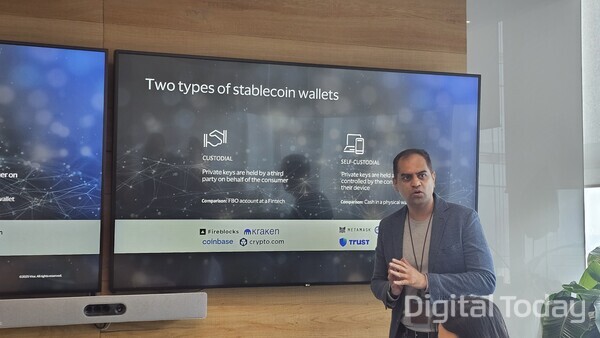
Nischint Sanghavi (니신트 상하비), head of digital currency for Visa in Asia Pacific, gave a presentation on Feb. 12 on how stablecoins are innovating existing payment and settlement structures and what strategic role Visa plays in a changing payments environment.
He stressed that stablecoins do not replace existing payment and settlement structures, but instead expand and complement them for the digital environment.
He explained that stablecoins can enable payment instructions and settlement to occur almost simultaneously in near real time, addressing structural limitations in the existing financial system. This improves flexibility and scalability across payment infrastructure, he said. He added that the shift suggests the payment structure itself is gradually evolving, beyond a simple improvement in payment speed.
Referring to market-specific demand and regulatory environments, he said, "Demand for stablecoins is surging globally, but how they are used differs depending on each market's environment." He said, "In advanced markets, stablecoins are being used as a key means for cryptocurrency trading and access to capital markets, while in emerging markets they are used as a dollar-based store of value and a way to access cross-border payments."
He also said stablecoins are emerging as a faster, more cost-effective alternative for person-to-person remittances, business-to-consumer payouts and supplier payments by small and medium-sized companies.
He added that regulatory discussions on stablecoins are becoming more concrete, mainly in the United States and Europe, and that these institutional moves are serving as a global benchmark for discussions in Asia Pacific, including South Korea. From Visa's perspective, he said, regulatory clarity is a positive factor that raises market trust and scalability.
On Visa's role as payment infrastructure, he said, "In the stablecoin ecosystem, it functions as a provider of global payments infrastructure." He said, "Visa will support enabling various stablecoins to link with existing payment networks."
He added, "Visa's role is to let consumers use stablecoins at Visa merchants while maintaining their existing card payment experience, and to help financial institutions and companies consider more flexible ways to move funds and settle." He said, "Based on its data analysis and consulting capabilities, it supports financial institutions in checking the potential to use stablecoins and designing a direction suited to their business."
 Lee Ji-young
ljy@d-today.co.kr
Lee Ji-young
ljy@d-today.co.kr