
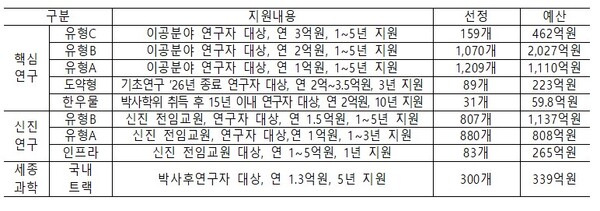
South Korea's Ministry of Science and ICT said on Wednesday it selected new projects under the Basic Research Program (individual research) for the first half of 2026. The selection will newly support a total of 4,628 researchers: 2,558 core research projects, 1,770 early-career research projects and 300 Sejong Science Fellowships (domestic).
That is 914 more projects than the same track a year earlier. The ministry said the increase reflects an expanded basic research budget and a strengthened researcher-centered support system. It plans to select about 2,000 additional basic research projects in the second half of this year.
Support for early-career researchers has risen sharply. The number of early-career research projects increased about 75 percent to 1,687 this year from 965 last year. The Sejong Science Fellowship (domestic track) also expanded to 300 from 200. The ministry is also working to create a long-term and stable research environment. In early-career research, it expanded 'seed research', previously supported for 1 year with 100 million won, to 3 years of support. It also expanded core research type A from 3 years with 70 million won to 5 years with 100 million won.
The ministry is also working to promote stable settlement for foreign researchers. In the selection evaluation for the first half, 114 foreign researchers from 24 countries were selected, up 78 from 36 in the same period last year. The government is lowering administrative barriers, such as allowing submissions of research plans in English, to support outstanding foreign researchers so they can conduct research stably in the country.
The ministry is also working to strengthen regional research capabilities. Of the 4,628 projects selected in the first half, 2,159 were projects carried out in regions, accounting for 47 percent of the total and up 618 from a year earlier. The number of selected projects also increased evenly by the four major and three special regions, strengthening regional basic research capacity overall.
Bae Kyung-hoon (배경훈), deputy prime minister and minister of science and ICT, said, "Since the launch of the new government, we have pursued the largest-ever research and development budget allocation and project selections to restore the basic research ecosystem that has collapsed." He added, "We will closely link the research growth ladder from Sejong to early-career to core research, and will proceed without disruption in supporting the remaining projects in the second half."
The results of the project selection will be individually notified to researchers on March 13.
 Jin-ho Lee
jhlee26@d-today.co.kr
Jin-ho Lee
jhlee26@d-today.co.kr