
[Digital Today reporter Jin-ho Lee (이진호)] The government will overhaul its strategic technology management framework and strengthen cross-ministry cooperation to respond to the race for technological leadership.
The Ministry of Science and ICT, the Ministry of Finance and Economy and the Ministry of Trade, Industry and Energy jointly drew up a plan titled "Direction (Draft) for Overhauling the All-Government Technology Management System and Strengthening Cooperation." They reviewed and approved it on Tuesday at the fifth meeting of ministers for science and technology-related affairs.
As global competition for technological leadership has intensified, the state's role has expanded in all areas, including research and development (R&D), industrial promotion and technology protection. South Korea has introduced various technology management systems to foster and protect strategic technologies, but critics have said policy linkages are weak because they are operated separately across laws and ministries.
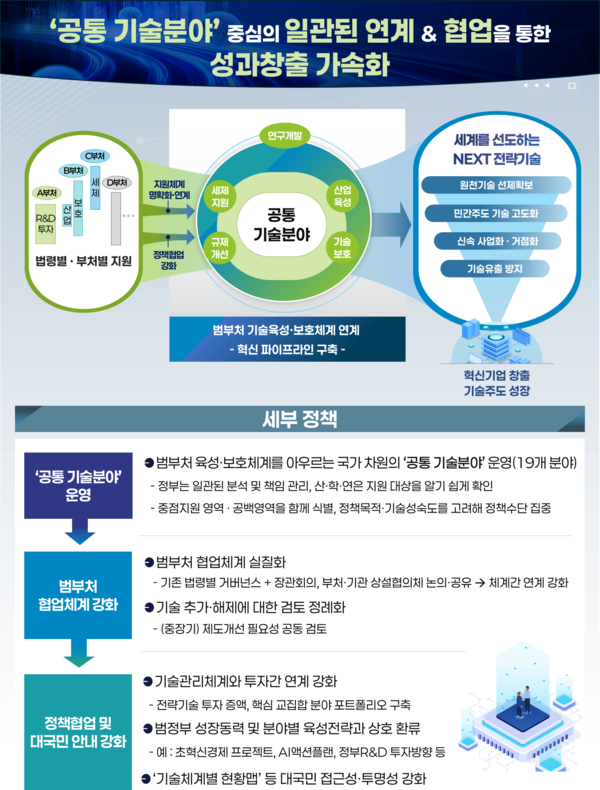
The government will strengthen links and cooperation among technology management systems to systematically manage the status of strategic technologies and provide focused support at the all-government level.
◆ Management system overhaul for 513 strategic technologies
The government will first overhaul technology management systems centered on 4 laws with high policy importance. The targets are the Act on the Fostering of National Strategic Technologies, the Restriction of Special Taxation Act, the Act on Special Measures for Strengthening and Protecting the Competitiveness of National High-Tech Strategic Industries, and the Industrial Technology Protection Act. It will first pursue system overhauls and cooperation for a total of 513 technologies.
To link these technology management systems, the government identified 19 shared technology fields, including semiconductors, displays, artificial intelligence (AI) and software, quantum, communications, cybersecurity, bio, robots, space and aviation, and secondary batteries. The shared fields were prepared through review meetings involving 104 participants, including officials from relevant ministries, working-level public institutions and field experts.
The government will secure linkage among the technology management systems under each law, centered on the shared fields. It expects the private sector will also be able to more easily identify technologies eligible for support and those subject to protection.
It also identified priority support areas that the 4 laws jointly foster or protect through field-by-field technology analysis. The government plans to concentrate R&D investment, tax support and industrial promotion policies in those areas to strengthen strategic technology competitiveness.
◆ Strengthening cross-ministry cooperation... linking R&D and policy finance
Ministries will expand advance discussions and information sharing on the direction of the technology management overhaul and procedures for designating technologies. They will jointly discuss changes to technology management systems at the national level through a joint meeting of the Meeting of Ministers for Science and Technology-Related Affairs and the Meeting of Ministers for Strengthening Industrial Competitiveness.
The government will also regularly convene a standing consultative body involving relevant ministries such as the Ministry of Science and ICT, the Ministry of Finance and Economy and the Ministry of Trade, Industry and Energy, as well as working-level agencies including the Korea Institute of S&T Evaluation and Planning, the Korea Institute for Advancement of Technology and the Korea Evaluation Institute of Industrial Technology. It plans to strengthen cooperation in the course of running the system.
It will also regularise reviews of adding and removing technologies so the technology management system can quickly reflect changes in the technology and industrial environment. In reviewing the system, it will comprehensively consider changes in the importance of technologies, policy objectives and consistency with other systems.
The government will also strengthen links with government R&D investment and policy finance so that designating strategic technologies does not end as simple list management. It will reflect this direction in the second national mid- to long-term R&D investment strategy, which is currently being prepared. It also plans to expand industrial infrastructure and corporate support through policy finance such as the National Growth Fund and the Science and Technology Innovation Fund.
It will also strengthen the government's "technology coordinating" function to help anyone easily understand and use benefits, obligations and applicable targets. It also built a "technology system status map" so researchers and companies can easily check support benefits and protection obligations related to strategic technologies. The government plans to continuously update it and to operate a portal that integrates and provides information on strategic technologies in the future.
Bae Kyung-hoon (배경훈), deputy prime minister and minister of science and ICT, said, "As global technology competition grows ever more intense, national strategic technologies are something the government and the private sector must develop and protect together." He added, "We will continue to communicate with relevant ministries so that researchers and companies clearly understand the system, properly receive support and reliably fulfil protection obligations."
 Jin-ho Lee
jhlee26@d-today.co.kr
Jin-ho Lee
jhlee26@d-today.co.kr