
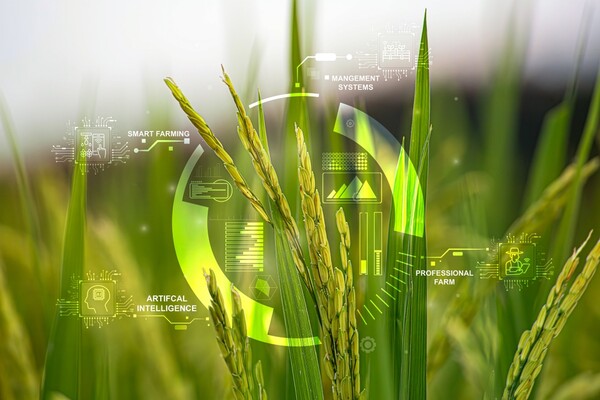
The government will pursue an 'Agriculture and Rural Artificial Intelligence Transition (AX) Strategy' that applies artificial intelligence (AI) to agriculture and rural areas to innovate from production to distribution and consumption, as well as rural life.
The Ministry of Agriculture, Food and Rural Affairs announced the strategy, drawn up jointly with relevant ministries, at the 5th Meeting of Ministers Related to Science and Technology held on Tuesday. The strategy focuses on using AI to build a competitive agricultural industry ecosystem and improve the quality of life for rural residents.
Where existing smart agriculture policy focused on production using advanced technology, the new strategy expands the policy scope to distribution, consumption and areas of rural residents' daily lives. It set the policy direction so people can benefit from AI regardless of the scale or conditions of their farming, moving away from technology dissemination centred on leading farms.
The government set a vision of 'making farming easier with AI, supply and demand more stable, and rural areas more convenient.' It will 추진 13 tasks in 4 key areas: innovating agricultural productivity, upgrading the agri-food distribution structure, improving rural residents' quality of life, and building the foundation for the AX ecosystem.
EXPANDING AFFORDABLE SMART FARMS... INTRODUCING SMART FARM EQUIPMENT SHARING CENTRES
In production, the government will provide AI solutions and infrastructure as a package, focusing on open-field farming where labour burdens are heavy. It will develop an affordable smart farm model and create experience spaces so small and mid-sized farms can use the technology without large-scale investment. It also plans to spread a voice-based AI service, 'AI Isak-i,' that uses farming technology information from the Rural Development Administration.
It also plans to introduce a county- and city-level 'smart farm equipment sharing centre' and improve the policy finance support system to reduce the burden of adopting high-priced farm machinery and AI farming solutions. Through a 'National Agriculture AX Platform,' it will create AI farms jointly with the private sector, and it will also 추진 an unmanned automation project using intelligent farm machinery and drones, tentatively named 'Nextfarm,' in cooperation with the Ministry of Science and ICT and the Rural Development Administration.
It will also increase the use of AI for disaster response. It plans to build AI-based disaster risk maps by analysing weather information and disaster data, and to manage agricultural groundwater preemptively by forecasting available volumes. It will use AI quarantine drones to assess the density of migratory bird habitats and will also 추진 a pilot project to automate key disinfection facilities without personnel.
APPLYING AI TO DISTRIBUTION AND LIVESTOCK... UPGRADING SUPPLY-DEMAND FORECASTING
In distribution, it will apply AI to smart Agricultural Products Processing Centers (APC), distribution hubs in production areas, to automate the intake, sorting and shipment process. The target is to build 300 smart APCs by 2030. It will pilot 3 sites this year for a logistics chain specialised for online transactions.
In livestock, it will expand an AI-based grading assessment system. It will select 2 slaughterhouses this year for AI grading of pig carcasses, and it plans to expand grading equipment for cattle to 52 sites nationwide. The goal is to raise the application rate of AI grading for major livestock types to around 70 percent by 2030.
It will also upgrade AI-based supply and demand forecasting models for key items such as rice, horticultural products and livestock products. In particular, it plans to use an agriculture and forestry satellite scheduled to be launched in the second half of 2026 to observe cultivation areas and shipment information for major crops and pursue more precise supply and demand forecasting. It will also pilot-launch an 'Smart Consumer Information app' in the second half of this year so consumers can compare agricultural product prices and check purchasing information.
EXPANDING SMART RURAL LIVING ZONES AND INCREASING RESEARCH AND DEVELOPMENT INVESTMENT
In rural living, it will expand 'smart rural living zones' that provide AI-based services to more than 100 locations by 2030. Considering the high share of older people in rural areas, it will introduce various services closely tied to daily life, including transport, daily living support and improvements to the rural environment. It will provide information on local resources such as unused rural facilities and traditional houses to boost start-ups and expand AI-based rural tourism services.
It will also expand AI education and hands-on experience opportunities centred on rural living social overhead capital. It will also pursue a plan to designate care coordinators in rural service communities as 'AI teachers' on a tentative basis to support residents' everyday use of AI.
It will increase research and development investment to support AX in agriculture and rural areas, including physical AI. It will provide tailored consulting and technology start-up funds for agri-food start-ups. The goal is to expand the cumulative number of agri-food start-ups to around 3,000 by 2030 from 1,279 as of 2024.
It also plans to introduce a data value assessment system to create an environment in which agricultural data can be traded and used. It will operate an AI-dedicated organisation and a public-private consultative body, and build a governance system that reflects field opinions in policy through cross-ministry cooperation.
Agriculture Minister Mi-ryeong Song (송미령) said, "AI is now not a choice but a core foundation that will determine the survival and future competitiveness of agriculture and rural areas." She added, "We will make 2026 the starting point for agricultural AX and create changes that can be felt across agriculture and rural areas."
Science Minister Kyung-hoon Bae (배경훈), who also serves as deputy prime minister, said the Ministry of Science and ICT would actively support the AI transition of agriculture and rural areas as the AI platform ministry. He added it would actively cooperate with the agriculture ministry and the Rural Development Administration in various areas, including enhancing agricultural AI technology, including physical AI, and systematic use of data.
 Jin-ho Lee
jhlee26@d-today.co.kr
Jin-ho Lee
jhlee26@d-today.co.kr