
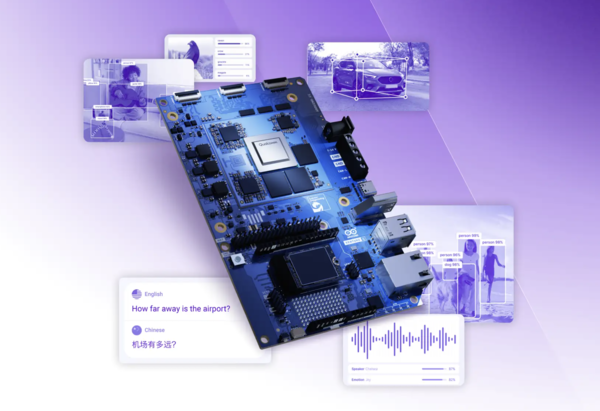
Arduino said on March 10 it launched its edge AI platform, Arduino Ventuno Q, ahead of Embedded World. Ventuno Q means "21" in Italian. Ventuno Q uses the Qualcomm Dragonwing IQ-8 series. Qualcomm acquired Arduino, which makes circuit boards and PCs for research institutes to build prototypes, in 2025.
The platform integrates AI computation and real-time control on a single board. It enables systems that go beyond recognition to real-world interaction. It handles AI and generative AI workloads and delivers up to 40 Dense TOPS of AI performance with NPU acceleration. It also includes an STM32H5 microcontroller to support low-latency actuation and motor control. With 16GB of RAM, it can run simultaneous inference and complex multitasking, and it supports up to 64GB of expansion storage.
Ventuno Q supports development of AI agent-based solutions that operate autonomously in offline environments. It can be used to develop an offline voice assistant based on a local large language model, a gesture-responsive smart mirror, and a tourist information kiosk using edge-based automatic speech recognition and text-to-speech. In robotics, it is used to build a vision-based pick-and-place robot arm, a user-recognition and follower service robot, and an autonomous mobile robot using visual SLAM and path optimisation.
The main processor runs Ubuntu and Debian Linux. A real-time microcontroller runs an Arduino core based on Zephyr OS to ensure deterministic operation for time-sensitive tasks. Through Arduino App Lab, developers can build Arduino sketches, Python scripts and various AI models in one environment, including local LLM, vision language models, automatic speech recognition, gesture recognition, pose estimation and object tracking. All AI functions run offline through the Qualcomm AI Hub.
It can run connected to a PC or independently as a single-board computer. It supports industrial I/O including CAN-FD, PWM and high-speed GPIO. It supports ROS 2-based robotics workflows by default and supports multiple MIPI-CSI cameras, audio and displays, and 2.5Gb Ethernet.
Fabio Violante (파비오 비올란테), vice president and head of Arduino Qualcomm Technologies, said, "With Ventuno Q, AI can finally move beyond the cloud into the physical world." He added, "This Ventuno Q platform can implement machines that perceive, decide and act on a single board."
Nakul Duggal (나쿨 두갈), senior vice president and head of automotive, industrial and embedded IoT at Qualcomm Technologies, said, "Ventuno Q reflects the shared vision of Arduino and Qualcomm to make edge AI more powerful and accessible." He added, "By combining the performance of Dragonwing processors with Arduino's vast developer ecosystem, we can provide advanced edge AI to millions of developers worldwide."
 Daegeon Seok
d2dg@d-today.co.kr
Daegeon Seok
d2dg@d-today.co.kr