
In the electric motorcycle industry, a view is spreading that, given current technology and cost structures, the opportunity lies in small, simple, city-focused electric motorcycles rather than expensive, high-performance models. While attention is focused on electric bicycles and advanced electric motorcycles, analysis says the real growth opportunity in electrification is in ultra-simple, low-cost models for the mass market, not advanced technology.
A recent patent application by Honda is drawing attention as an example of this trend. The patent, spotted by AMCN's Ben Purvis (벤 퍼비스), is interpreted as a design that has cost-sensitive markets in mind, such as parts of India and Africa where commuter motorcycles are a main mode of transport.
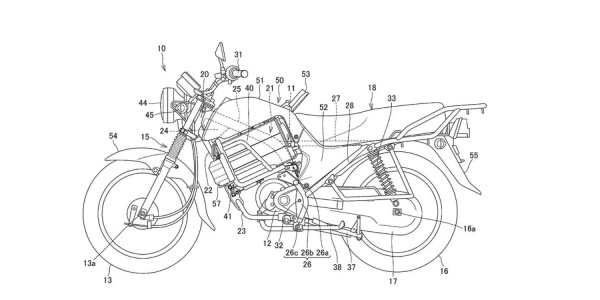
On Feb. 3, local time, electric vehicle outlet Electrek reported that the patented model is strikingly traditional in appearance and structure. It uses a steel frame with proven durability and lower production costs instead of an aluminium frame or advanced electronic equipment. Classic dual rear shocks, cable-operated drum brakes and a minimal body setup evoke small internal-combustion commuter motorcycles.
The difference lies in the drivetrain. A small electric motor sits where a small air-cooled single-cylinder engine would normally be, and two removable batteries are mounted where a fuel tank would be. The approach is similar to a previously disclosed patent for an electric motorcycle based on the Honda Shine 100, but it shows clear differences in the battery structure.
The core of the patent is the battery mounting method. The batteries are not permanently fixed inside the frame but inserted into a metal cage structure positioned on both sides of the body. The cage opens on a front hinge, and the batteries swing outward as they are removed. After inserting the batteries and closing the cage, the batteries align with cutouts in the tank-shaped body and are firmly secured.
Security is also ensured with a minimal structure. A lockable flap on top of the tank hides a manual latch, preventing the battery cage from being opened without a key. The starting method also keeps a traditional key start, and the instrument panel is a simple layout showing only essential information such as speed and battery charge status.
Charging is also thoroughly simplified. Complex hardware such as an onboard charger or automatic connector is excluded. The method is to remove the batteries, charge them indoors, then reconnect them with a flexible cable. This is interpreted as a choice aimed at improving usability even in areas with limited power infrastructure.
Notably, Honda did not apply its own swappable battery standard that it already holds to this design. This appears to be the result of prioritising a slim battery shape and a simple structure, and is interpreted as a strategy that puts cost reduction first, as with a recently disclosed fixed-battery model.
Honda did not disclose specific performance figures such as battery chemistry, range and power output. Even so, the direction shown throughout the patent is clear. It aims to lower the entry barrier for electric motorcycles by implementing an electric drivetrain cheaper than a small gasoline engine.
It remains unclear whether the patent will lead to a mass-produced model, but the high level of design completion suggests it is likely a preliminary step for future model development. In the industry, an assessment is emerging that the patent symbolically shows the solution for wider adoption of electric motorcycles may be less technology and a lower price, not more technology.
 Jinju Hong
hongjj@d-today.co.kr
Jinju Hong
hongjj@d-today.co.kr