
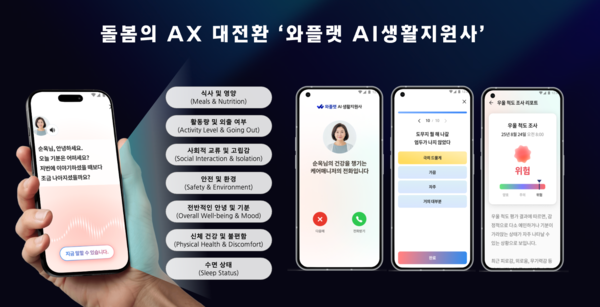
NHN’s senior-care subsidiary Waplat said on Tuesday it will begin full provision of its artificial intelligence (AI) daily living support aide service after completing a pilot project carried out with the Korea Association of Senior Welfare Centers.
The project focused on verifying the effectiveness of AI functions upgraded from the existing service. It added a conversation service based on a generative large language model (LLM) that regularly checks seven major risk factors, including seniors’ mood, health and sleep. It also added a tailored care survey function that periodically assesses depressive emotions and nutrition risk, among other factors.
The pilot ran from November last year at 10 implementing institutions nationwide and targeted seniors with an average age of 77.2.
Waplat’s AI daily living support aide is a service that uses smartphones to minimise care gaps around the clock. It supports integrated management across areas including safety, wellbeing checks, health, daily living and emotions. With only an app installation, it detects movement and links abnormal signs to monitoring and dispatch. It also includes healthcare functions approved as medical devices by the Ministry of Food and Drug Safety, enabling cardiovascular health measurement by placing a finger on the rear smartphone camera.
To improve user-friendly access, Waplat set a persona based on a female care aide in her 50s who works in the field. It used AI human technology to create a face and designed the service to enable natural conversation, reducing resistance.
The pilot results showed an average app usage rate of 98 percent despite the elderly participants being unfamiliar with digital devices. The AI conversation completion rate more than doubled compared with the early stage of adoption, and the number of participants in the tailored care survey rose 2.2 times. The results showed that digital literacy among older people is not a major barrier to introducing AI care.
Waplat currently has business agreements with 23 local governments and plans to expand the service to about 40 local governments nationwide this year.
Hwang Sun-young (황선영), Waplat’s chief executive, said, "We upgraded the service while thinking about the most comfortable way for seniors." She added, "Based on the pilot results, we will strengthen integrated care functions in line with the government’s AX transformation drive."
 Lee Ho-jung
lhj@d-today.co.kr
Lee Ho-jung
lhj@d-today.co.kr