
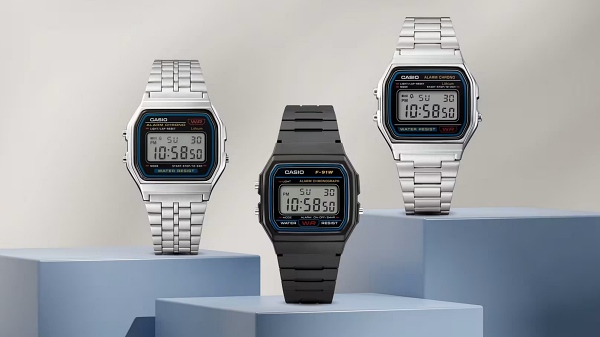
Casio's digital watch "F-91W" is an iconic steady seller that almost anyone can recognise from a photo, even without knowing the model name. Since its 1989 launch, it has remained in production with almost no design changes. With strong value for money and a simple structure, it gained worldwide popularity and the nickname "cheap Casio". An open-source replacement circuit board for the F-91W called "Sensor Watch" has emerged and is drawing attention.
On Dec. 30, online media outlet Gigazine reported that the F-91W has left behind many legendary anecdotes thanks to a simple LCD layout focused on essential functions, a light fit and long battery life. Its official battery life is 7 years, but there are cases in which it ran for 20 years with only a 7-minute error.
Overseas, it is being revisited as part of a "Casio Vintage" line contrasted with newer G-SHOCK models. Despite a flood of replicas, it continues to hold a firm position thanks to Casio keeping the original in production. It is also known as a watch worn by both former U.S. President Barack Obama and Osama bin Laden, one of the model's best-known anecdotes.
As the F-91W has been loved for so long, more units have stopped working over time due to internal parts reaching the end of their life. At the same time, gadget enthusiasts have steady demand to expand internal functions while keeping the exterior unchanged. Sensor Watch emerged in response to these needs. The project works by replacing the F-91W's original circuit board and is designed on an open-source basis.
Sensor Watch is based on an ARM Cortex-M0+ microcontroller. It supports a 32 KHz quartz for a real-time clock with an alarm function, a 10-digit segment LCD, three interrupt-capable buttons, and a red and green PWM-dimming LED backlight. An optional piezo buzzer can be used. It also provides easy firmware updates through an onboard USB micro-B connector and a UF2 bootloader. Replacing the board, however, is a modification that requires disassembly and soldering, voids the manufacturer's warranty and carries a risk of reduced water resistance, meaning it must be done entirely at the user's responsibility.
The replacement procedure is relatively clear if users follow the video guide posted on the official Sensor Watch site. After removing the back cover, users remove the rubber gasket and movement, separate the original board and battery, then solder the buzzer connector to the replacement board. It can then be assembled in reverse order to operate. The buzzer connector soldering step is considered the most difficult part of the process.
The completed Sensor Watch provides two screen systems: a primary list and a secondary list. The primary list focuses on everyday functions such as a clock and stopwatch, while the secondary list allows users to check temperature display, diagnostic information and detailed settings. It keeps using the F-91W's existing MODE, ALARM and LIGHT buttons, while also being designed to control various functions by combining short and long presses.
Sensor Watch is seen as an example of reinterpreting a decades-old digital watch as a modern experimental platform, beyond being a simple repair part. Because it can completely rebuild the internals while preserving the F-91W's classic appearance and symbolism, it is attracting interest from vintage digital watch enthusiasts and the maker community.
 Jinju Hong
hongjj@d-today.co.kr
Jinju Hong
hongjj@d-today.co.kr