
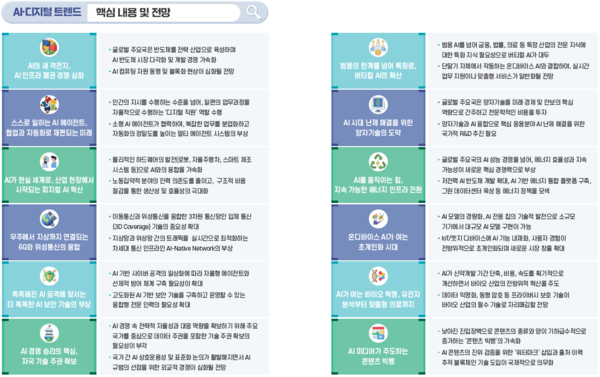
South Korea's National Information Society Agency (NIA) published a report on "12 AI and Digital Trends for 2026 Forecast by NIA" on Wednesday.
The agency analysed economic, industrial and social outlooks, policy directions in major countries and key global issues based on future outlook reports projected by major institutions and research bodies at home and abroad. It derived 10 core technologies and 12 AI and digital trends.
The 12 AI and digital trends selected were: "A new battleground for AI: Intensifying competition for dominance in AI infrastructure"; "Self-working AI agents: A future reshaped by collaboration and automation"; "AI into the real world: Physical AI innovation starting at industrial sites"; "The convergence of 6G and satellite communications linking space to the ground"; "The rise of smarter AI security technology to counter smarter AI attacks"; "The key to winning AI competition: Securing technological sovereignty"; "Beyond the limits of general purpose to specialisation: The spread of vertical AI"; "A leap in quantum technology to solve hard problems in the AI era"; "The power driving AI: A shift to sustainable energy infrastructure"; "A hyper-personalised era opened by on-device AI"; "A bio revolution opened by AI, from genetic analysis to personalised medicine"; and "A content big bang led by AI media."
The agency said it analysed economic, industrial and social prospects as well as policy directions in major countries and key global issues based on future outlook reports predicted by major domestic and overseas institutions and research bodies, and derived 10 core technologies and 12 AI and digital trends.
Through the AI and digital trends, the agency said it noted that AI is emerging beyond simple industrial innovation to become core to rivalry among countries and strategic assets. It presented "A new battleground for AI: Intensifying competition for dominance in AI infrastructure" and "The key to winning AI competition: Securing technological sovereignty" as trends.
It also projected a fundamental transformation across industries, citing "Self-working AI agents: A future reshaped by collaboration and automation," "AI into the real world: Physical AI innovation starting at industrial sites" and "Beyond the limits of general purpose to specialisation: The spread of vertical AI" as trends showing AI entering a stage where it operates as an actor performing work beyond an assistive tool.
It forecast that AI will accelerate innovation across everyday life by expanding personalised services, citing "A hyper-personalised era opened by on-device AI," "A bio revolution opened by AI, from genetic analysis to personalised medicine" and "A content big bang led by AI media."
In the trends "The convergence of 6G and satellite communications linking space to the ground," "The rise of smarter AI security technology to counter smarter AI attacks," "A leap in quantum technology to solve hard problems in the AI era" and "The power driving AI: A shift to sustainable energy infrastructure," it stressed the importance of core technologies and infrastructure that enable stable operation and long-term spread of AI technologies alongside the realisation of a hyper-connected society driven by wider AI adoption.
Hwang Jong-sung, head of NIA, said 2026 will be a turning point when AI emerges beyond technological innovation to become core to national competitiveness and social development.
 Jinho Lee
jhlee26@d-today.co.kr
Jinho Lee
jhlee26@d-today.co.kr