
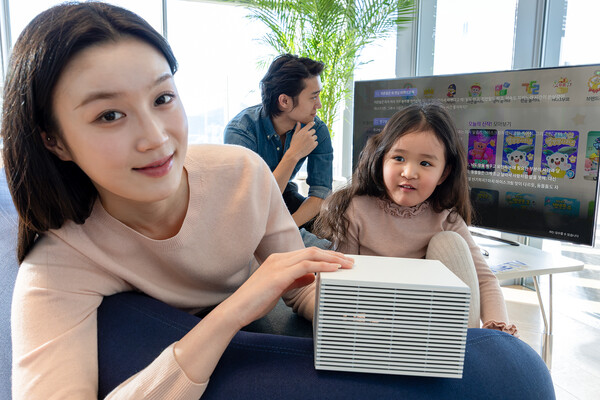
KT said on Jan. 29 that Genie TV is evolving into a next-generation AI platform that can freely converse with people after applying an AI agent.
KT said the core of Genie TV innovation is Media Agent technology, designed around a collaboration structure between a Master Agent and Sub Agents.
The Master Agent is the central control hub of Genie TV's dialogue system. It analyzes user utterances and understands the conversational context, then selects the most suitable Sub Agent and integrates the results. The selected Sub Agent performs actions suited to its role and generates an optimal response.
Sub Agents are specialized modular AI systems with roles tailored to different areas. Each Sub Agent follows a three-step procedural reasoning process: normalizing natural language into a form the model can interpret, setting a reasoning structure, and performing actual actions. This minimizes unnecessary inference or hallucinations and provides a more accurate and natural conversational experience.
This allows users to find content with only a plot outline or a brief description. They can identify a movie title using only a partial depiction of a scene, such as: "What is the movie where people get out of their cars and dance on a jammed elevated highway?" If a user asks, "Find movies about school," Genie TV searches for works that include school-related themes or objects and provides information.
Genie TV's AI agent also provides a multi-turn dialogue service beyond one-way or one-time voice commands. It has also significantly improved voice recognition accuracy to more than 95 percent, enabling more natural, more human-like conversations.
The Genie TV AI agent also serves as an intelligent partner that reflects personal preferences. When short-term memory (STM) stores recent conversation content, long-term memory (LTM) extracts and retains information that is meaningful over the long term.
LTM excludes spontaneous or inaccurate content such as "hello" among user utterances stored in STM and keeps only information worth remembering. If it stores only explicitly expressed facts such as "documentary preference" from "I watch documentaries a lot these days," it refines the information by comparing it with existing LTM. It then manages the user's profile information and behavioral history separately and uses them for personalized responses.
Under a multi-LLM strategy, the system automatically calls the most suitable model for the user's question intent to maintain dialogue quality. As part of that strategy, Genie TV's AI agent uses Azure OpenAI Service introduced in cooperation with Microsoft and a Korea-specific AI model, SOTA K, based on GPT-4o. KT plans to expand multi-LLM integration and continue to pursue securing multimodal models.
The application of SOTA K to Genie TV's AI agent is the first case of its introduction to a B2C service since the model was released in September. KT said it shows the成果 of strategic cooperation between KT and Microsoft. SOTA K is a collaborative model that precisely combines Korean language and Korean social and cultural context with the global top-level performance of GPT-4o.
A KT official said, "KT will continue to develop the Genie TV AI agent and evolve it into a conversational AI platform that goes beyond media services and permeates more deeply into users' lives."
 Jin-ho Lee
jhlee26@d-today.co.kr
Jin-ho Lee
jhlee26@d-today.co.kr