
The government will concentrate available government resources to speed up a national AX drive. It will introduce a new Public Nuri category so public works can be freely used for AI training without legal uncertainty.
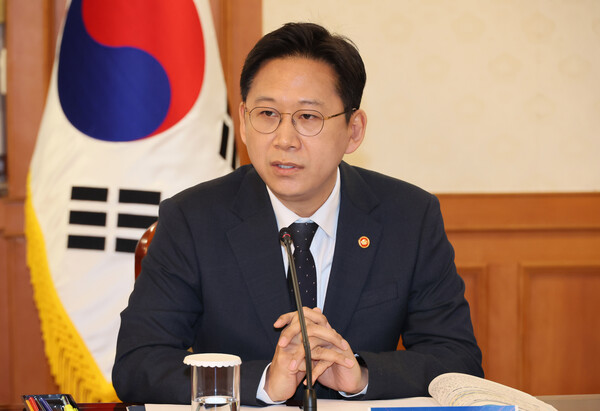
The government held the fourth meeting of science and technology-related ministers on Jan. 28. Starting with this meeting, it introduced an intensive discussion format for key agenda items. The aim is to strengthen policy linkages and coordination among ministries by deeply discussing major pending issues in science and technology and AI and matters requiring cross-ministry cooperation.
It will establish a second R&D investment strategy in the first half and push AX across all sectors.
Relevant ministries discussed a draft direction for establishing the second national R&D investment strategy for 2026 to 2030. The mid- to long-term national R&D investment strategy is the government's top-level R&D strategy that sets investment goals and direction for the next 5 years.
The discussion focused on 10 strategies to create and spread results, designed around a one-team strategy that brings together government and private-sector capabilities. It also included thoroughly mission-oriented R&D, and end-to-end investment without breaks from R&D to market creation, to deliver clear results within 5 years.
Based on the discussion, the government will establish the second national mid- to long-term R&D investment strategy in the first half of the year through about 160 experts on field-specific committees, consultations with relevant ministries and public hearings.
It also discussed a draft one-stop support plan covering the full lifecycle of government AX projects. A total of 33 ministries, agencies and commissions will invest a budget of 2.4 trillion won, five times larger than last year, to push AX across all sectors. It will build a government-wide AX collaboration system centred on the ministers' meeting to create successful cases early.
Under the one-stop support plan, the government will first select "national projects" at the planning stage by reflecting ministry demand and other factors, then concentrate available government resources such as GPUs. It will provide AX planning consulting to ministries that want it through an "AX advisory group" made up of dedicated AI agencies and field-specific AI experts. It will also prepare "AX guidelines" containing success cases, key considerations and field-specific information.
At the implementation stage, it will tailor support for the technology and infrastructure each ministry needs, including GPUs, AI models and talent. If necessary, it will provide additional advanced GPUs held by the government. It will provide technical consulting so proprietary AI foundation models can be used. It will also support development of specialised public and administrative AI services for each ministry using a government-wide common AI platform.
The Ministry of Science and ICT and the Ministry of the Interior and Safety plan to operate an "AX one-stop support centre" and a "public AI project support centre", respectively, to provide AI technology and infrastructure resources and detailed information needed by each ministry.
It will add an AI category to Public Nuri and offer incentives for companies to voluntarily inspect security vulnerabilities.
The government also reported measures to expand use of public works for AI training, improving rules so individuals and companies can freely use public works held by the state, local governments and public institutions for AI training.
It will introduce new Public Nuri categories that can be used for AI training. It will add Public Nuri "Type 0", which can be freely used without conditions for any purpose, including AI training. It will also create an "AI type" that allows free use for AI training while maintaining existing conditions for other uses.
In September last year, the government allowed a national AI elite team to use about 11,000,000 items of Type 1 and Type 3 content for AI training, out of 33,400,000 Public Nuri items, under a regulatory sandbox pilot exemption. Under the revision, if public works fall under Type 0 or the AI type, anyone will be able to use them freely for AI training. It will also operate a consultation channel at the Korea Culture Information Service Agency so people can ask whether public works can be used for AI training.
The government also announced a draft second comprehensive information protection measure, supplementing a government-wide information protection master plan established in October last year. It includes strengthening a system of actual damages compensation for consumer harm. It also includes measures to provide incentives so companies introduce systems to voluntarily disclose and fix vulnerabilities through white hackers and others. The package also includes strengthening security for general products that include digital elements.
The meeting also discussed a draft strategy for a "Korean-style Genesis Mission K-moonshot". It will later finalise the strategy based on the discussion.
Bae Kyung-hoon (배경훈), deputy prime minister and minister of science and ICT, stressed that the government will bring together capabilities across ministries centred on the ministers' meeting, combine South Korea's competitiveness in AI, semiconductors and manufacturing, and push policies forward quickly.
 Jin-ho Lee
jhlee26@d-today.co.kr
Jin-ho Lee
jhlee26@d-today.co.kr