
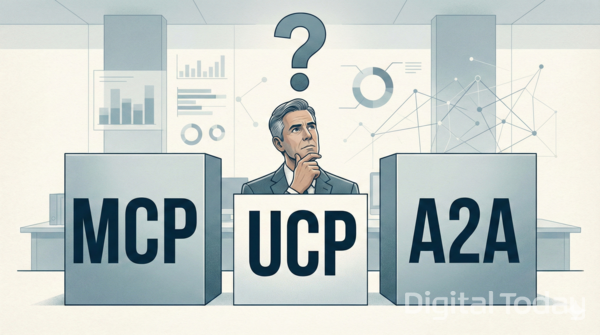
Various protocols that support AI shopping are emerging one after another.
Protocols with distinct roles are appearing, including A2A, MCP and UCP, and the AI-based shopping ecosystem is becoming more specific.
These protocols are complementary rather than competitive. For example, if a user tells an AI chatbot, "Find white running shoes," the chatbot will ask the AIs of multiple shopping malls, "Do you have white running shoes?" The agent-to-agent protocol (Agent-to-Agent Protocol·A2A) supports this.
A2A, announced by Google in April 2025, can be seen as a common language used when AI agents communicate. After its release, the technology was donated to the Linux Foundation and became an open standard with more than 150 companies participating.
Before A2A, AI agents such as Gemini, ChatGPT and Llama had to use separate proprietary code to talk to each other. Implementing A2A allows A2A-supported agents to communicate immediately, reducing complexity.
A shopping mall AI that receives an answer must find white running shoes in its own database. The Model Context Protocol (MCP) supports this. Unlike A2A, which connects AIs to each other, MCP is a protocol that connects various tools or data to AI. Anthropic announced it in November 2024.
MCP is about reusability. Anthropic provides MCP servers for major systems such as Google Drive, Slack and GitHub, making reuse possible even if the AI model is swapped out. Alex Albert (알렉스 알버트), head of developer relations at Anthropic, said, "MCP will become the USB-C port for the AI agent era."
For AI shopping to take hold, product information also needs to be standardised. In this context, the Universal Commerce Protocol (Universal Commerce Protocol·UCP), announced in January under Google's lead, is drawing attention.
Foreign media such as TechCrunch liken UCP to HTTP. Just as the internet grew after HTTP became a web standard in the 1990s, UCP defines all information related to shopping, from product discovery to cart management, payment, delivery and after-sales management.
Through dynamic negotiation, it enables payment methods to be automatically adjusted based on variables such as cart amount or the buyer's region. The approach is to suggest Kakao Pay in South Korea and Apple Pay in the United States, offer free delivery for orders over 40,000 won at Kurly, and apply store-by-store delivery policies on Naver Shopping.
In this process, sellers retain control. Google provides only the platform that connects AI and shopping malls, and sellers manage customer data and transaction records directly.
AI shopping protocols are evolving through cooperation among various companies. More than 150 companies including Google, Microsoft and Adobe participate in A2A. UCP was jointly developed by Google and Shopify, and is backed by more than 20 companies including Walmart, Target and Visa. This is seen as a result of industry stakeholders aligning on the view that building an ecosystem is a prerequisite for AI shopping to spread.
Harley Finkelstein (할리 핀컬스틴), president of Shopify, said, "The future of commerce should not be behind closed doors controlled by a specific giant platform," adding, "Open standards will be the most powerful weapon to help every seller, regardless of size, maintain their own brand and ride a new wave called AI."
 Seul-gi Son
sageson@d-today.co.kr
Seul-gi Son
sageson@d-today.co.kr