
Daedong said on Thursday it achieved results in AI-based farm support and advanced precision agriculture technologies through its smart farming cooperation with the Rural Development Administration. The two sides launched a "smart farming cooperation consultative body" in May last year and have pursued a total of 18 joint tasks across four working groups: data, precision agriculture, green bio and smart farms, and field expansion.
In the data group, Daedong developed an "AI disaster warning service" using the agency’s API for its "agricultural weather disaster early warning service". Introduced to the Daedong Connect app in August last year, it is the first privately commercialised AI-based agricultural disaster prediction service. It provides disaster risk alerts up to 10 days in advance based on plot and crop information. It also provides response guidelines by cultivation stage. It has been assessed as improving farmers’ preparedness efficiency by applying ultra-precise weather disaster forecasts in 30-metre units, compared with existing 5-km grid forecasts.
Daedong also upgraded the agricultural consultation function of "AI Daedongi", trained on the agency’s farming data. It focused on improving consultation accuracy by comprehensively training on plant diseases and pests, cultivation techniques and book materials for 12 major crops. By 2025, cumulative questions exceeded 100,000. The company explained that demand for digital-based farming consultations is rising rapidly, with more than 8,000 uses a month on average. Daedong plans to add an AI call-based farm log service in the second quarter this year to the Daedong Connect app, which exceeded 40,000 subscribers last year.
In precision agriculture, it carried out field demonstrations across 231 plots nationwide. It lowered the fertiliser prescription error rate to 4.29 percent. Nitrogen uniformity after variable-rate fertiliser application improved 73 percent versus the previous level. The correlation of topdressing maps created using satellite and drone data was 0.97, confirming the possibility of implementing precise growth maps comparable to drones using satellite data alone. Daedong plans to expand on-site deployment of satellite- and drone-based fertiliser application technology.
Daedong will build a "full-cycle data-based precision agriculture system" by 2026. It will push practical technology upgrades, including calculating appropriate fertiliser amounts, reducing environmental loads, developing a rice protein estimation model and detecting lodging areas. Through its precision agriculture platform, it is building an environment where farmers can easily check the information they want on the web and apps. It will later add functions such as automated topdressing prescriptions, free satellite growth monitoring and farm work outsourcing, and push to expand into a service spanning farms, local governments and corporations.
In the green bio group, the agency identified the sleep quality improvement functional material "Girincho" as a strategic material and carried out cultivation demonstrations. Daedong confirmed the possibility of improved productivity versus open-field cultivation through smart farm greenhouse cultivation at its Seoul office. On smart farms, Daedong is working with the Ara Greenhouse Platform consultative body, the agency’s project to standardise domestic greenhouse data and environmental control, to improve the efficiency of greenhouse environment management.
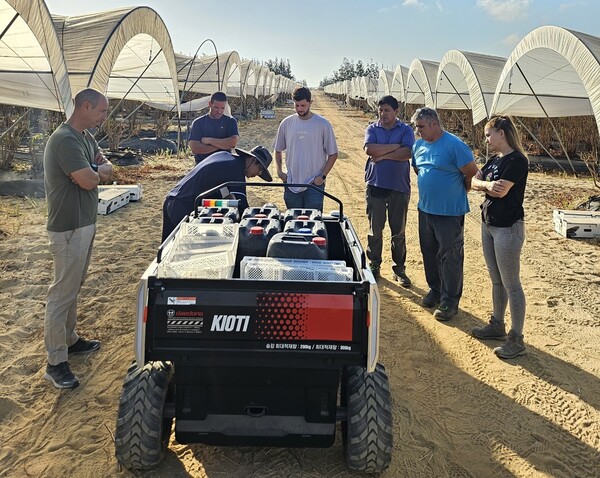
In the field expansion group, it verified the economic feasibility and usefulness of robotics and precision agriculture technologies. After carrying out crop transport work using Daedong’s autonomous transport robots at an apple farm in Geochang and a peach field in Okcheon, the working time at the two farms fell by up to 10 percent from the previous year. The agency will expand demonstration targets and areas this year, and Daedong plans to advance transport robot and variable-rate fertilisation technologies through technology transfer from the agency.
Youngjoong Na (나영중), vice president of group management at Daedong, said, "Through cooperation with the Rural Development Administration, we confirmed tangible on-site results of AI and data-based agricultural technologies." He added, "We will create a sustainable future for our agriculture by industrialising research results and expanding smart farming technologies."
 Daegeon Seok
d2dg@d-today.co.kr
Daegeon Seok
d2dg@d-today.co.kr