
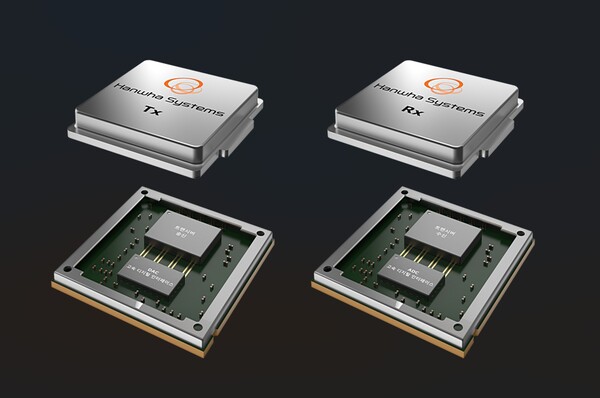
Localisation of defence semiconductor technology is accelerating through industry-academia cooperation. Hanwha Systems said on Wednesday it will establish joint research and development centres with Seoul National University and Sungkyunkwan University to secure defence and space semiconductor design technologies. The joint research centres will be set up at Seoul National University's Semiconductor Inter-university Research Center and at the College of Information and Communication Engineering on Sungkyunkwan University's Natural Sciences Campus.
Defence semiconductors are specialised chips used in advanced weapon systems such as missiles, radar and military communications, and require far higher reliability and stability than chips for other industries. Hanwha Systems and Seoul National University will conduct joint research through 2031 to develop high-frequency communications semiconductor design technology. The chip is a key component that can be applied to communications satellites, mobile terminals and drones. It is expected to contribute to ultra-high-speed, low-latency, high-performance military communications that connect land, sea, air and space domains on future battlefields.
In December, Hanwha Systems won a development project for a transceiver space semiconductor for low Earth orbit communications satellites, one of the semiconductors used for communications. The transceiver space semiconductor is a key component for implementing military low Earth orbit satellite communications and is designed to reliably transmit and receive satellite communications between the ground and space in extreme space environments. A transceiver is a device that combines transmitter and receiver functions.
With Sungkyunkwan University, the company will jointly develop a domestically made high-power, high-efficiency, wideband semiconductor for radar. The chip is a key component in radar used in surface-to-air guided weapon systems, fighter jets and observation satellites. It performs target search and tracking functions by generating radio waves and amplifying received signals. It can be used broadly in multi-function radar applied to Cheongung-II and L-SAM, as well as AESA radar for fighter jets and SAR on observation satellites.
Hanwha Systems plans to build infrastructure for joint research with each university and proceed in stages, from preliminary research on core technologies to securing the technology and commercialising components into products. It will also pursue mid- to long-term cooperation such as expanding personnel exchanges between industry and academia and hiring talented staff.
A Hanwha Systems official said the cooperation was an important starting point for stably securing core defence semiconductor technologies in South Korea. The official said the company would raise self-reliance in core semiconductor technologies for defence through continued R&D and talent development and contribute to strengthening the competitiveness of South Korea's defence industry.
 Dae-geon Seok
d2dg@d-today.co.kr
Dae-geon Seok
d2dg@d-today.co.kr