
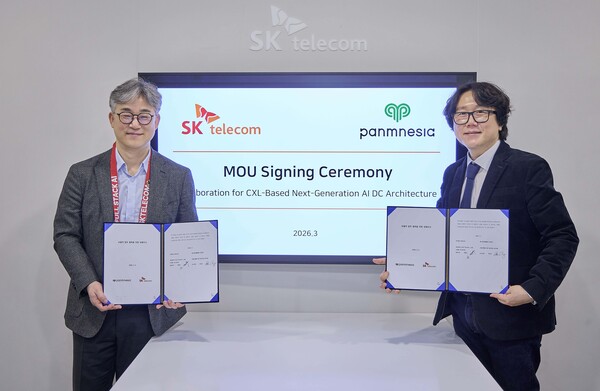
BARCELONA, Spain - SK Telecom is teaming up with computing interconnect company Fanessia to pursue structural innovation in AI data centres. With memory demand surging as AI models become more advanced, the strategy is to change how resources are connected to improve performance and cost efficiency at the same time.
SKT said on March 4 it signed a memorandum of understanding with Fanessia at MWC 2026 being held in Barcelona, Spain, to jointly develop a "CXL (Compute eXpress Link)-based next-generation AI data centre architecture".
Fanessia is a domestic startup with CXL technology at a top global level. It is developing link semiconductors needed to build AI data centres, including fabric link switches and link controllers.
CXL is a data interconnect standard that organically links data between central processing units (CPUs), graphics processing units (GPUs) and memory to enable ultra-fast, low-latency data processing. It allows resources that were tied to server units to be expanded and used more flexibly.
The core of the partnership is to use CXL-based technology to raise AI processing efficiency without unnecessary equipment expansion and to improve data centre economics. Existing AI data centres have a structure in which CPUs, GPUs and memory are fixed at the server level. When memory runs short, the inefficiency of having to add more GPUs than needed is repeated, increasing build and operating costs.
The two companies will apply CXL-based technology to expand the scope of resource interconnection from inside servers to rack level, and shift to a structure that can flexibly combine CPUs, GPUs and memory.
SKT will lead architecture design optimised for commercial environments, while Fanessia will use its range of link semiconductor technologies to expand an interconnect structure previously limited to within servers to rack level and beyond.
The partners will run actual AI models to verify GPU and memory utilisation rates and latency, and will unveil the next-generation AI data centre architecture by year-end. They plan to pursue commercialisation after demonstrations in large-scale AI data centre environments.
Seok-geun Jeong (정석근), head of SKT's AI CIC, said AI data centre competitiveness depends on system optimisation including memory and data flow, beyond GPU performance. He said the partnership would ease the "memory wall" bottleneck, where data movement and supply fail to keep up with computing performance, to raise performance and economics together.
Myung-su Jeong (정명수), CEO of Fanessia, said next-generation AI infrastructure performance is determined by various link semiconductor architectures rather than individual equipment. He said the company would present a high-efficiency AI data centre standard model that global markets will focus on.
 Jin-ho Lee
jhlee26@d-today.co.kr
Jin-ho Lee
jhlee26@d-today.co.kr