
Global telecom equipment company Ericsson highlighted the importance of AI-based radio access networks and a transition to 5G standalone mode.
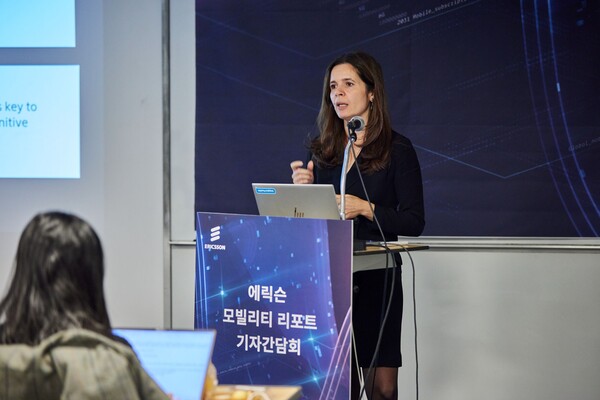
Ericsson Korea held a media briefing on Dec. 10 at the Korea Chamber of Commerce and Industry in central Seoul. The company presented next‑generation network strategies to support traffic shifts in the AI era.
The recently published Ericsson Mobility Report said uplink traffic has surged due to generative AI and increased real‑time media consumption. It said this makes a full redesign of network structures unavoidable.
Ericsson proposed AI RAN as its answer. AI RAN learns and predicts traffic patterns in real time, automatically optimises resources and supports precise QoS control.
Ericsson said these functions are possible only in a 5G standalone structure. Sibel Tombaz, CEO of Ericsson Korea, said the company will speed up 5G SA transitions with Korean operators and use AI RAN to respond flexibly to changing traffic demand. She said this is the starting point of a shift toward a more agile and smart digital ecosystem.
The latest report also included 5G SA use cases such as broadcast production, live sports, cloud uploads and analyses of Singtel, SoftBank and SailGP. Ericsson also stressed the importance of open standards and multi‑vendor integration for AI RAN deployment.
Ericsson said it plans to continue actively supporting operators with 5G SA and AI RAN.
 Jinho Lee
jhlee26@d-today.co.kr
Jinho Lee
jhlee26@d-today.co.kr