
In the first evaluation of the government-led sovereign AI foundation model project, known as Dokpamo, Naver Cloud was unexpectedly eliminated. Whether the model was built “from scratch” emerged as the deciding factor in judging independence. The industry is watching closely, expecting independence to remain the key yardstick in future evaluations.
◆ 'From scratch' emerges as a key evaluation variable
Dokpamo is a national project aimed at resolving technological, cultural and economic security dependence stemming from reliance on global AI models. Its goal is to secure AI models that can be independently used in areas closely tied to daily life to help the country become one of the top three in AI.
The project put “independence” at the center from the call for proposals. The Ministry of Science and ICT defined Dokpamo in its guidance as a domestic model that carries out everything from model design to pre-training, rather than a derivative model developed by fine-tuning an overseas model. That means even a high-performing model does not qualify as sovereign AI if it is simply a modification of an overseas model.
This is why “from scratch” has drawn attention. It refers to independently carrying out AI model planning and construction from start to finish, including data collection, model design, building training algorithms and data processing. Industry expectations were that from scratch would play an important role in this project’s evaluation, given the government’s emphasis on independence.
Against this backdrop, Naver Cloud’s use of a vision encoder from Alibaba’s open-source AI model Qwen 2.4 in its “HyperCLOVA X Seed 32B Think” triggered controversy over whether it was built from scratch. A vision encoder is a module that converts image, video and voice data into numerical values so AI can understand them.
In AI models, weights are numerical values that express the results of data, computation and selection. They are effectively the model’s “intelligence”. Borrowing a vision encoder could be seen as borrowing eyes or ears, but critics said taking the weights meant borrowing another model’s intelligence as well.
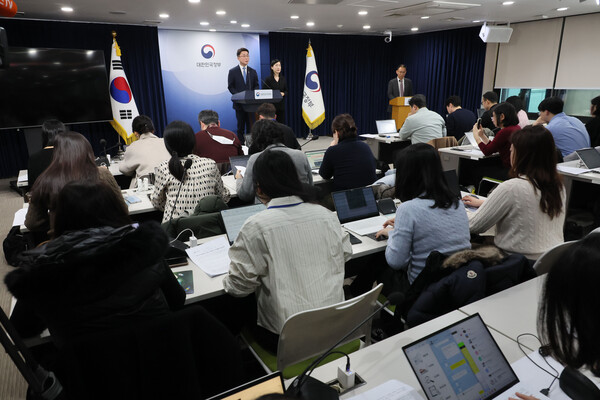
The ministry also viewed Naver Cloud’s adoption of weights from a Chinese model as falling outside the from-scratch standard. Naver Cloud passed the benchmark evaluation but failed the independence assessment. Announcing the first evaluation results, the ministry explained: “Using open source is a common trend, but initializing weights and then training while developing an AI model is the basic condition for an independent AI model broadly accepted across the AI industry and academia in Korea and abroad.”
Seong-yeop Lee, a professor at Korea University’s Graduate School of Management of Technology, said, “Considering the purpose of sovereign AI emphasized by the government, Dokpamo must not carry the risk of technological dependence.” He added, “The ministry’s judgment this time was already predictable.” He said that given the project seeks AI to apply to national core infrastructure, it would have been difficult to pass a team embroiled in controversy over use of external models.
◆ Calls grow for resetting the standard for 'independence'
Some also argue it is unreasonable to treat even simple borrowing of architecture as a violation of from-scratch requirements. With open-source use already the dominant trend, and given the project targets 95 percent of global model performance, they argue limited use of overseas models should be allowed as long as there are no licensing issues.
Kyung-jeon Lee, a professor in Kyung Hee University’s Department of Big Data Applications, said, “There is a need to reconsider treating from scratch as the core.” He said, “What matters is the rights relationship.” From a sovereign AI perspective, he said, what matters is control to modify and operate the model independently, meaning there is no need to insist on from scratch if those conditions are secured.
There are also criticisms that the elite teams participating in Dokpamo face limits in judging independence. That is because AI models combine various elements, including data training, structural design, inference methods and data processing. Seong-yeop Lee said it may be necessary for the government to specify criteria for independence as concretely as possible.
The industry interprets Naver Cloud’s elimination as an opening signal of the strength of the sovereign AI model policy. It expects the independence debate to recur in future evaluations. An industry official said, “In the competition ahead, emphasizing independence as well as performance will be a point to watch.”
In the first evaluation, NC AI was eliminated along with Naver Cloud. NC AI did not clear the benchmark evaluation threshold.
In line with its original plan to eliminate only 1 team in the first evaluation, the ministry will select 1 additional team and conduct the second-stage evaluation with 4 elite teams. Naver Cloud and NC AI said they would not try again, and Kakao, which was eliminated in the first call for elite teams, also said it would not participate.
The industry sees KT, Motif Technologies and Konan Technology, which were eliminated in the first call for elite teams, as among those most likely to try again.
 Jin-ho Lee
jhlee26@d-today.co.kr
Jin-ho Lee
jhlee26@d-today.co.kr