
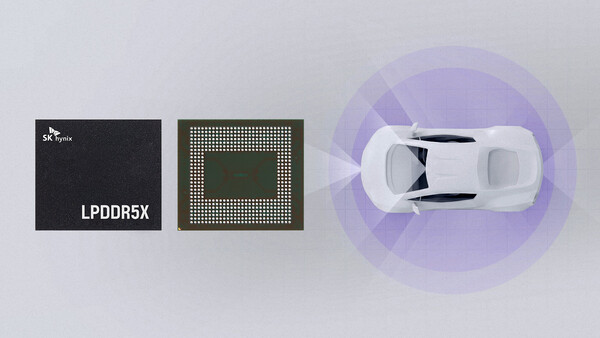
[DigitalToday reporter Daegeon Seok] SK hynix said on Jan. 19 it has obtained ISO 26262 ASIL-D certification for its LPDDR5X automotive DRAM. ASIL-D is the highest grade under the international functional safety standard for automobiles. It is the highest level of functional safety grade applied to systems directly related to human life.
With the certification, SK hynix met performance, safety and reliability requirements at the same time in the automotive memory market. The product has high performance, low power consumption and high reliability required for ADAS, autonomous driving and in-vehicle infotainment. The company said it stably processes large volumes of data in an SDV environment and minimizes the possibility of system errors.
SK hynix said its LPDDR5X automotive DRAM delivers stable data reliability even in extreme environments. It applied fault notification and self-diagnosis and repair functions. It said it obtained ASIL-D certification by balancing ultrahigh bandwidth with low-power characteristics.
According to SK hynix, the automotive industry environment is being reshaped around SDVs and autonomous driving. With the share of electrical and electronic systems in vehicles exceeding 40 percent, system reliability has become a key factor directly linked to passenger safety.
ISO 26262 functional safety certification is a mandatory requirement. It is an international functional safety standard for automobiles established by the International Organization for Standardization in 2011. It was designed to prevent accidents caused by failures of electrical and electronic systems in vehicles. Requirements for automotive semiconductors were added in 2018.
ASIL assigns grades from A to D by combining three risk factors: severity, exposure and controllability. For autonomous driving control systems, ASIL-D, the highest level, is mandatory. SK hynix said it built an LPDDR5X automotive DRAM lineup and completed ASIL-D certification to respond proactively to customer requirements.
SK hynix said it built an FSM to control systematic defects and managed the entire process from development to mass production through a standardized process. It emphasized that it documented every step systematically, from defining customer requirements to design, verification and mass-production management.
It also said it built a management system based on metrics such as SPFM, LFM and PMHF to respond to random failures. ASIL-D requires SPFM of at least 99 percent, LFM of at least 90 percent and PMHF of 10FIT or less. To meet those requirements, it applied safety mechanisms starting at the circuit and device design stages, including ECC-based data error correction, redundancy of repair fuses for defect response, and fault notification functions based on diagnosing error severity.
SK hynix said it plans to provide memory solutions in autonomous vehicles and future mobility based on the certification.
 Daegeon Seok
d2dg@d-today.co.kr
Daegeon Seok
d2dg@d-today.co.kr