
South Korea's Ministry of Science and ICT will hold a "2026 Joint Briefing on Government R&D Programmes" from Jan. 19 to 21 at the main auditorium of KAIST in Daejeon.
This year's government R&D budget totals 35.5 trillion won. The expanded budget will be invested in future growth engines such as AI, semiconductors, quantum, advanced bio, energy and aerospace, as well as in strengthening the research ecosystem through expanding basic research, reinforcing talent development and balanced regional development.
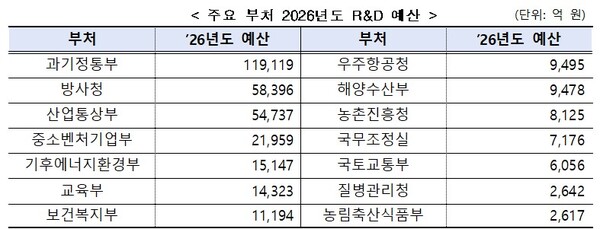
In 2026, 33 ministries, agencies and offices will pursue R&D. By investment size, the ranking is the Ministry of Science and ICT, the Defense Acquisition Program Administration, the Ministry of Trade, Industry and Energy, the Ministry of SMEs and Startups, the Ministry of Climate, Energy and Environment, the Ministry of Education, the Ministry of Health and Welfare and the Korea AeroSpace Administration, in that order.
To help researchers understand government R&D programmes across ministries in one place, 18 ministries, including the Ministry of Science and ICT, the Ministry of Trade, Industry and Energy and the Ministry of SMEs and Startups, will jointly hold the briefing.
On the morning of the first day, Jan. 19, the Office of Science and Technology Innovation will explain key features of the 2026 government R&D budget, measures to innovate the R&D ecosystem, follow-up systems after the abolition of preliminary feasibility studies, expansion of autonomy in research funds and stronger sanctions against misuse. In the afternoon, the Ministry of Science and ICT, the Korea AeroSpace Administration and the Ministry of Land, Infrastructure and Transport will present key R&D programmes and implementation schedules for each ministry.
On Jan. 20, the Ministry of Education, the Ministry of SMEs and Startups, the Ministry of Trade, Industry and Energy, the Ministry of Health and Welfare, the Korea Disease Control and Prevention Agency and the Ministry of Food and Drug Safety will introduce the government programmes under their jurisdiction. On Jan. 21, explanations will be given in the order of the Ministry of National Defense, the Ministry of the Interior and Safety, the Ministry of Climate, Energy and Environment, the Ministry of Oceans and Fisheries, the Ministry of Agriculture, Food and Rural Affairs, the Rural Development Administration, the Korea Forest Service and the Ministry of Culture, Sports and Tourism.
The online live broadcast can be watched on the day of the briefing through the official website and the Ministry of Science and ICT's YouTube channel. Materials distributed at the briefing can also be checked on the official website. The ministry plans to provide recorded videos and presentation materials for each ministry even after the briefing ends.
Park In-gyu, head of the Office of Science and Technology Innovation, said the expanded budget will be focused on technology-led growth in areas such as AI, energy and strategic technologies. He said efforts are also under way to restore the basic research ecosystem and build a virtuous-cycle research ecosystem in which companies and regions grow together. He added that institutional improvements are also being pursued by reflecting voices from the research field, including a phased abolition of PBS and the abolition of the preliminary feasibility study system.
 Jinho Lee
jhlee26@d-today.co.kr
Jinho Lee
jhlee26@d-today.co.kr