
The government will draw up detailed implementation standards for the "Republic of Korea AI Ethics Principles" enacted in August. An explanatory guide to the principles will be released within the year, and a self-checklist that AI operators and others can use will be issued next year.
The Korea Information Society Development Institute (KISDI) is preparing follow-up materials to support the implementation of the ethics principles by AI developers, suppliers and users, it said on Nov. 26. It is also reviewing ways to reflect youth protection-related items in the self-checklist.
Moon Jung-wook (문정욱), head of KISDI's AI Policy Research Division, said the goal was to provide detailed guidelines so the principles could be applied in industrial settings, rather than revising the principles themselves. He said the guide would be released within the year and the self-checklist next year, adding that youth protection-related items were also being reviewed.
The ethics principles were enacted and promulgated on Aug. 21 based on Article 27 of the AI Basic Act. They succeeded the "National AI Ethics Standards" prepared in 2020 while reflecting technological and social changes stemming from the spread of generative AI and AI agents. They include what actors across the AI lifecycle should practice, including securing human control over AI, preventing overreliance, and preventing misuse and abuse.
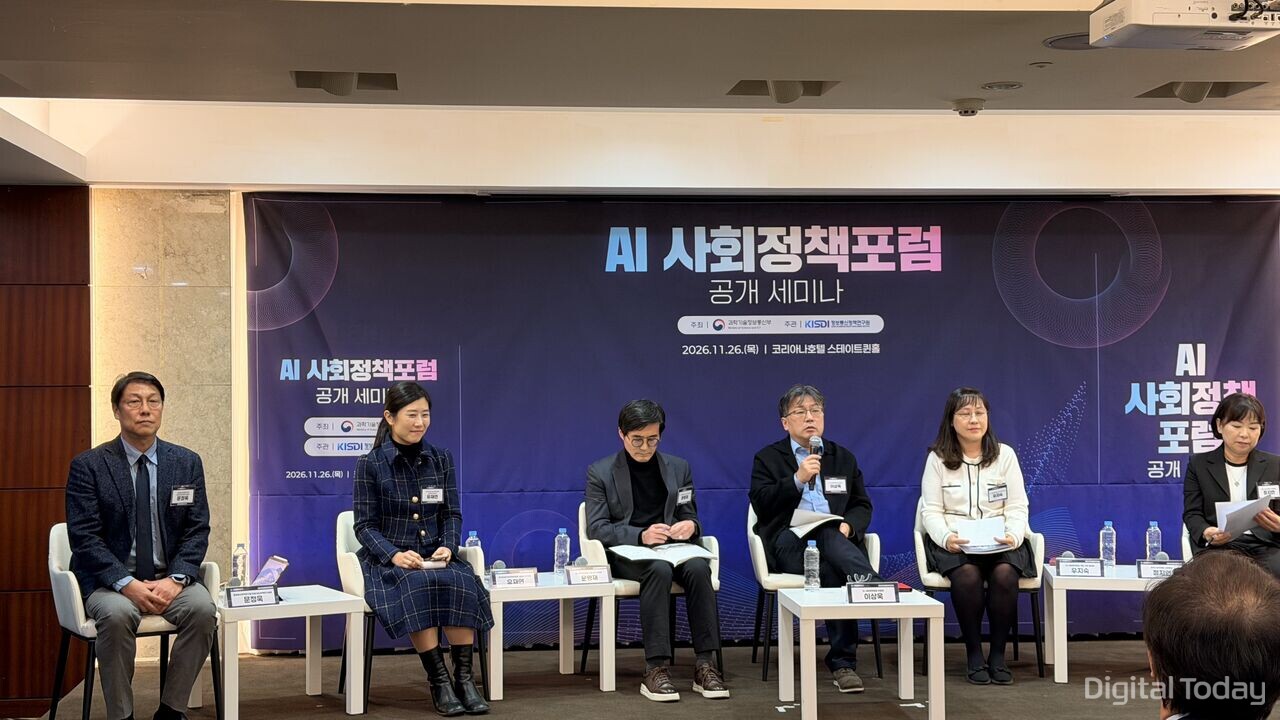
The Ministry of Science and ICT and KISDI held the "2026 AI Social Policy Forum Open Seminar" at the Koreana Hotel in Jung-gu, Seoul, on the day and discussed social issues from the spread of AI and policy response measures.
Lee Sang-wook (이상욱), chair of the AI Social Policy Forum committee and a professor in the Department of Philosophy at Hanyang University, said in a keynote speech that while AI bias and fairness were mainly discussed in 2020, new issues have recently emerged, including responsibility and the controllability of agentic AI. He said an ongoing practical process of reflecting such issues was at the core of AI ethics and governance.
KISDI operated four research groups this year on training data copyright, transparency of AI-generated content, labour market transition and youth protection. Experts from academia, industry and civil society took part, and a report containing the findings will be released at year-end.
In particular, the youth protection research group proposed safety design and operation measures proportionate to service functions and risks, rather than uniform restrictions on AI use. It proposed five types of protective measures, including preventing exposure to illegal and harmful information, easing emotional dependence, preventing excessive immersion, responding to crisis situations, and reporting and support for guardians, as well as pre-release safety assessments and age-tailored design.
The policy recommendations also included imposing obligations on AI developers to record and retain training data and differentiating labelling of outputs depending on the degree of AI contribution and the risk of harm. It was also pointed out that platforms' management responsibilities should be specified at the distribution stage of AI-generated content.
Eom Yeol (엄열), director general for AI Policy at the Ministry of Science and ICT, said in welcoming remarks that the seminar would not end as a one-off presentation and collection of opinions. He said venues for sharing views together with the public should continue.
 Seulgi Son
sageson@d-today.co.kr
Keyword
#KISDI #Ministry of Science and ICT #Republic of Korea AI Ethics Principles #AI Basic Act #AI Social Policy Forum
