
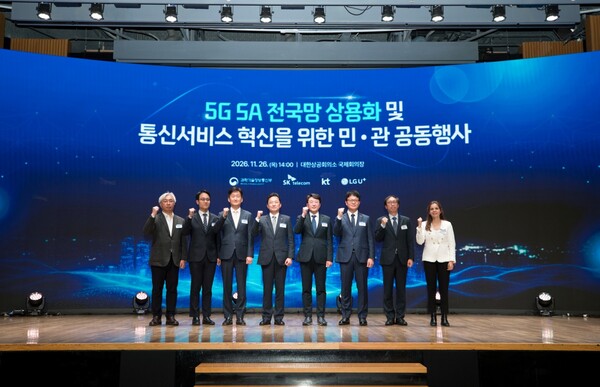
The era of nationwide 5G standalone (SA) service has begun. Competition in telecom services, which has focused on speed since 5G commercialisation in 2019, is expected to expand to tailored quality competition such as ultra-low latency and high reliability. The Ministry of Science and ICT is moving to provide institutional support, including updating its explanation of network neutrality guidelines and overhauling the telecom service quality assessment system.
The Ministry of Science and ICT on Wednesday held a public-private joint event with SK Telecom, KT and LG Uplus at the Korea Chamber of Commerce and Industry international conference hall in Seoul to mark the commercialisation of nationwide 5G SA and innovation in telecom services.
=== Mobile carriers open 5G SA era, shifting competition beyond speed to tailored quality ===
5G SA is a telecom network built entirely with 5G technology, from base stations that transmit and receive radio waves to the core network responsible for subscriber authentication and data processing. Existing 5G non-standalone (NSA) provides services by linking a 5G radio access network with an LTE core network.
South Korean carriers adopted the NSA approach at the time of the world’s first 5G commercial launch in 2019 because it could use existing LTE infrastructure. KT commercialised 5G SA in July 2021. LG Uplus will start 5G SA service on Nov. 30 and SK Telecom on Dec. 1, opening the era of a nationwide 5G SA network.
One of the core technologies of 5G SA is network slicing. It divides a single physical network into multiple logical networks to provide the communications quality required for each service. Services that need high-volume data transmission can receive high transmission speeds, while services that require real-time response such as remote robot control or emergency rescue can receive low latency and high reliability.
A representative example is a priority access service for emergency communications. Even if traffic concentrates in a specific area, it can support stable communications for disaster response personnel by allocating network resources needed for emergency communications first.
The ministry views nationwide commercialisation of 5G SA as an important foundation for preparing for the AI era. It considers upgraded telecom networks essential given the characteristics of the AI industry, which requires exchanging large volumes of data and connecting various systems.
Woo-hyuk Choi (최우혁), director-general for Information Security and Network Policy at the Ministry of Science and ICT, said, "The launch of nationwide 5G SA service is not completion but the start line." He said support devices must be continuously expanded so anyone can fully enjoy the benefits. He added the ministry would work actively to establish a reasonable institutional foundation and to spur telecom network investment and build an ecosystem.
=== Network neutrality criteria to be specified, promoting tailored telecom services ===
The ministry will also supplement its explanatory guide to network neutrality guidelines to promote the launch of new services based on 5G SA. Network neutrality is the principle that telecom operators should not unreasonably discriminate against traffic transmitted over the internet.
The ministry introduced provisions for "specialised services" requiring guarantees of specific communications quality when it revised the guidelines in 2020, but there has been criticism of regulatory uncertainty because criteria for recognising specialised services are unclear. In particular, clear criteria were needed for representative 5G SA use cases such as network slicing and priority access services for emergency communications.
Under the ministry’s plan to supplement the guide, telecom operators must provide advance notice of the quality level and conditions of tailored telecom services and user protection measures if contracted quality is not met. They must secure spare network capacity to ensure that providing tailored services does not degrade communications quality for general users.
It plans to allow exceptions for public safety services directly linked to people’s lives and safety, such as priority access for firefighters’ emergency communications, even if they partly affect general internet quality. If problems such as quality degradation occur, it plans to demand the submission of materials on quality impact from telecom operators and, if necessary, to check additional network investment and implementation status.
The ministry will also overhaul the telecom service quality assessment system. It will move away from assessments centred on download speed and use various indicators such as SA connection success and retention rates, upload speed and latency. It also plans to assess whether required transmission speeds are met by service type, including web searches, social media short-form videos, video conferencing and high-definition streaming.
If network slicing products are launched in the future, it will also consider measuring communications quality between subscribers and non-subscribers to assess whether quality for general users declines and the level of contracted quality assurance by product.
=== Mobile carriers step up search for SA businesses, seeking AI and 6G infrastructure competitiveness ===
The three mobile carriers are also speeding up efforts to find new businesses based on 5G SA. They are also responding to new communications demand stemming from AI transformation (AX) at industrial sites and the spread of physical AI.
SKT has secured and built network capacity and coverage over the past year and prepared device support. It built a quality analysis system and completed the optimisation process. SKT will first pursue a 5G SA pilot service to keep subscribers’ communications quality stable in crowded situations such as festivals and performances. It is also seeking enterprise services such as robot control at industrial sites.
Jung-hwan Ryu (류정환), an SKT vice president, said, "In the 6G and AI era, 5G SA inevitably becomes a very important infrastructure." He said, "In business-to-business (B2B), we are exploring four areas: manufacturing AX and physical AI, industrial safety, and the public sector."
KT, which was the first among South Korean carriers to commercialise 5G SA, will move to expand services based on its experience so far. It plans to find new demand through app slicing technology that controls communications quality at the application level and enterprise security services.
Young-in Kim (김영인), a KT vice president, said, "5G SA is a foundation that can respond more flexibly to various service demands." He said it is important for devices and equipment to develop along with networks and for multiple industries to cooperate closely.
LG Uplus will expand services to industrial sites and public areas such as firefighting and emergency medical care. It plans to respond to changes in telecom traffic structure due to the spread of AI and the internet of things (IoT). It will run a 5G SA experience group at Gocheok Sky Dome on Dec. 5.
Yong-hyun Kwon (권용현), an LG Uplus vice president, said, "We are witnessing IoT and AI traffic increase exponentially." He stressed that preparations are needed for uplink traffic and network slicing.
Separately, the ministry will pursue network stabilisation, pilot measurements of quality and joint demonstrations of new services to prevent user inconvenience in the early stage of 5G SA commercialisation. It also plans to find everyday services and push links to standardisation.
Choi said, "5G SA is a solid stepping stone toward the coming 6G and AI era." He added, "The government and private sector will work together so it can lead to next-generation telecom competitiveness."
 Jin-ho Lee
jhlee26@d-today.co.kr
Keyword
#5G SA #Ministry of Science and ICT #SK Telecom #KT #LG Uplus
