
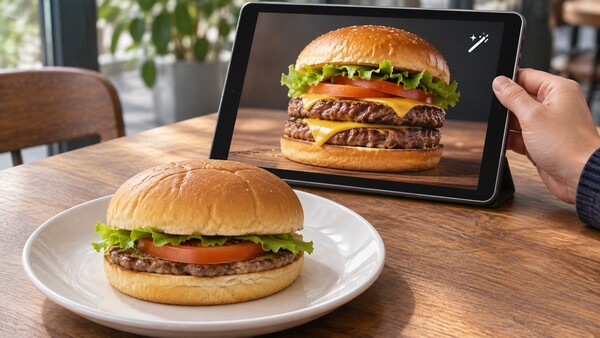
AI-produced product images are spreading across the food service industry and the e-commerce market, widening legal disputes over false and exaggerated advertising. They can cut image production costs and improve marketing efficiency, but could face legal sanctions if differences from the actual product affect consumers' purchasing decisions.
On Nov. 26, Japanese media outlet ITmedia reported that attorney Maeno Kotaro (前野 孝太朗), a legal expert in AI and IT, said AI-generated images used on restaurant menus are subject to the same standards under the Act against Unjustifiable Premiums and Misleading Representations as existing advertising images.
Japan's law bans representations that could mislead consumers into believing a product or service has quality or content that is markedly better than it actually is.
For example, if an actual hamburger contains only 1 thin patty but an AI-produced menu image includes 2 thick patties, it is highly likely to constitute a legal violation. Even if the business did not intend it, it could be subject to sanctions if AI added ingredients that are not in the actual product. Simply adding a notice such as "AI-generated image" or "image staged" also may not avoid legal liability.
Other countries are also overhauling regulatory frameworks for false and exaggerated advertising using AI. The U.S. Federal Trade Commission bans ads that deceive consumers or lack objective grounds under existing advertising rules. Since October 2024, it has also regulated fake product reviews generated with AI.
The European Union has applied transparency-related obligations for AI-generated content under Article 50 of the AI Act since August. Under its existing Unfair Commercial Practices Directive, it also bans ads that mislead consumers about a product's composition, quantity or quality.
Britain's Advertising Standards Authority also said in advertising guidance updated in September that showing ingredients or side dishes not included in the actual product in images can cause consumers to be misled.
China introduced a labelling system for AI-generated and synthetic content in September last year. The State Administration for Market Regulation also released in September cases it said it had caught of false advertising that used AI virtual humans in online sales broadcasts to claim ordinary foods had effects like health functional foods.
South Korea's Fair Trade Commission revised its review guidelines from June to require disclosures that endorsing and guarantee ads using AI virtual humans are virtual. On Oct. 22, it released a draft guideline detailing standards for judging unfair AI-related advertising.
As matching between the actual product and ad content becomes more important than producing ads with AI itself, pre-verification of generated images and advertisers' management responsibility are emerging as new tasks for companies.
 Choi Jae-won
ittt_0801@d-today.co.kr
Keyword
#Premiums and Representations Act #FTC #European Union #AI Act #Korea Fair Trade Commission
