
Support from the Broadcasting and Communications Development Fund is skewed toward terrestrial broadcasters, critics said. As competition in the broadcasting industry intensifies with the spread of over-the-top (OTT) services, they argued that not only fairness in levies among operators but also the fund's spending structure needs to be overhauled.
A forum titled "Ways to Restructure the Broadcasting and Communications Development Fund in the Audiovisual Media Era" was held on Nov. 26 at the National Assembly Members' Office Building in Yeouido, Seoul. It was jointly hosted by Democratic Party lawmakers Kim Woo-young, Han Jun-ho, Kim Hyun, Kim Nam-kuk, Lee Yeon-hee, Lee Ju-hee, Lee Hoon-gi and Hwang Jung-a, and independent lawmaker Choi Hyuk-jin.
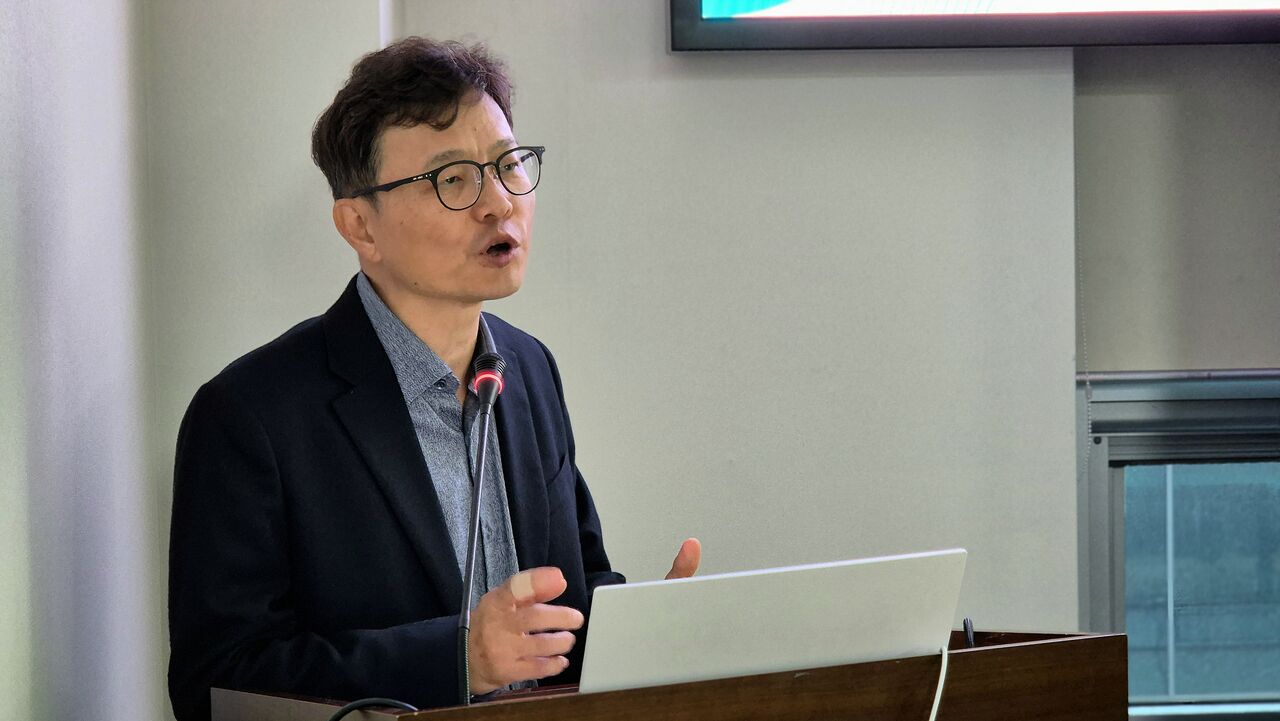
Data presented by Hong Jong-yoon (홍종윤), a professor in the Department of Communication at Seoul National University, showed that in fund support programmes under the Broadcasting and Media Communications Commission in 2022-2026, terrestrial broadcasters paid 134.3 billion won in contributions and received 230.8 billion won in support. The ratio of support to contributions reached 172 percent.
Over the same period, cable TV paid 122.0 billion won but received only 3.4 billion won in support. The ratio of support to contributions was 2.8 percent. Comprehensive programming programme providers and news channel programme providers recorded ratios of 7.7 percent and 5.1 percent, respectively. IPTV, satellite broadcasting and home shopping did not receive benefits from the support programmes.
A similar concentration of support appeared in Broadcasting and Communications Development Fund programmes overseen by the Ministry of Science and ICT. Of the 52.0 billion won投入 in 2020-2024 for a programme to support production of broadcast programmes, 89.1 percent of total support was allocated to three groups: independent production companies (44.8 percent), general programme providers (23.6 percent) and terrestrial broadcasters (20.7 percent).
Hong said the fund levied from pay-TV operators is effectively being used to support other operators such as terrestrial broadcasters, raising potential unfairness among operators competing in the same market.
Concerns were also raised about fairness among operators in the levy system. While terrestrial broadcasters, comprehensive programming channels and news programme providers are subject to progressive levy rates and reduction rules based on factors such as revenue scale and financial condition, pay-TV platforms such as cable TV, IPTV and satellite broadcasting have been subject since 2017 to a single levy rate equivalent to 1.5 percent of broadcasting service revenue.
Hong proposed unifying the criteria for imposing the levy based on broadcasting-related revenue and establishing a reduction system based on operators' ability to bear the burden and public interest. He said projects with low relevance to the fund's purpose should be shifted to the general account, and repetitive and customary support programmes should be reorganised.
In a general discussion, speakers also presented specific measures to improve the spending structure. Yoo Sung-jin (유성진), a professor in the School of Business Administration at Soongsil University, proposed gradually shifting support for institutions such as the Press Arbitration Commission to the general account and deducting half of cable TV regional channel operating costs from contributions. He said the aim was to create a structure in which the fund directly recirculates to operators that carry out public responsibilities.
Yoo stressed that transparency in fund management should be strengthened, including by evaluating fund support programmes every three years to decide whether they should continue and disclosing annually, by project, the amount of support provided to contributing operators.
Shin Sang-jin (신상진), an attorney at Garojae Law Office, suggested expanding the contribution exemption system for loss-making operators to include pay-TV operators. He said the decrease in fund resources due to reductions should be addressed by reorganising existing spending rather than passing the burden onto other contributing operators.
Over the mid to long term, a proposal was presented to reorganise the fund into an "Audiovisual Media Development Fund" that would cover OTT services and platforms once it exceeds a certain size.
As a transitional alternative, a plan was also discussed to integrate the Broadcasting and Communications Development Fund with the Information and Communications Promotion Fund and abolish broadcasters' contributions, so the resources can be invested directly in content production and public-interest projects.
 Seul-gi Son
sageson@d-today.co.kr
Keyword
#Broadcasting and Communications Development Fund #OTT #Cable TV #Ministry of Science and ICT #National Assembly
