
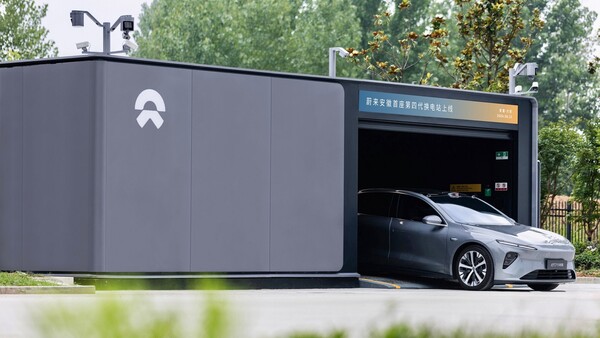
[DigitalToday reporter Jae-won Choi] Chinese electric vehicle maker Nio (NIO) set a goal of expanding battery swap stations to more than 10,000 by 2030 and managing battery assets worth more than 350 billion yuan (about 70.6 trillion won). The strategy is to foster battery asset management and energy infrastructure businesses as key growth engines beyond EV sales.
Electrek reported on Nov. 25 (local time) that Nio unveiled the mid- to long-term business plan at its annual technology event, "NIO IN 2026," held in Guangzhou, China. Nio Power, its energy business unit, also plans to increase annual power supply through charging and battery swapping to more than 10 billion kilowatt hours (kWh) by 2030.
As of that day, Nio had built 4,285 battery swap stations and 5,611 charging stations across China. The cumulative number of battery swap services provided has exceeded 130 million.
The company must sharply raise the pace of infrastructure buildout to meet its goals. Based on the current scale of swap stations in China, it would need to add about 1,400 stations each year over the next four years, but new swap station buildouts in 2024 and 2025 totaled 679 and 681, respectively.
The capital burden from securing large-scale battery assets is also a challenge. Nio's battery subscription service (BaaS) sells vehicles and batteries separately, requiring a substantial level of battery inventory and swap infrastructure to provide stable service.
Nio is reducing the capital burden through external investment and joint ventures with partners. In September it signed a strategic agreement with China's Geely Automobile Group on battery swapping and charging businesses. Once the deal is completed, the Geely group will secure a 30 percent stake in Nio Power. The number of battery swap stations jointly built with partners has also surpassed 900.
It is also accelerating technology upgrades. The fifth-generation battery swap station introduced in August supports all three of its sub-brands, including Nio, Onvo and Firefly. It is also pushing to improve efficiency in battery asset and swap station operations using AI agents.
With Chinese competitors such as BYD accelerating development of ultra-fast charging technology, maintaining the competitiveness of battery swapping and securing returns on infrastructure investment are expected to be Nio's key challenges.
 Jae-won Choi
ittt_0801@d-today.co.kr
Keyword
#Nio #Geely Automobile Group #Nio Power #BaaS #BYD
