
The National IT Industry Promotion Agency (NIPA) has begun improving its evaluation method ahead of the third-stage review of the domestic AI foundation model project. It plans to keep the overall framework of the current evaluation while reflecting points that have been raised to improve fairness.
In the 'AI for All' project, a public AI service, it will strengthen personal data protection and safety measures while promoting an ecosystem that allows various AI agents to participate.
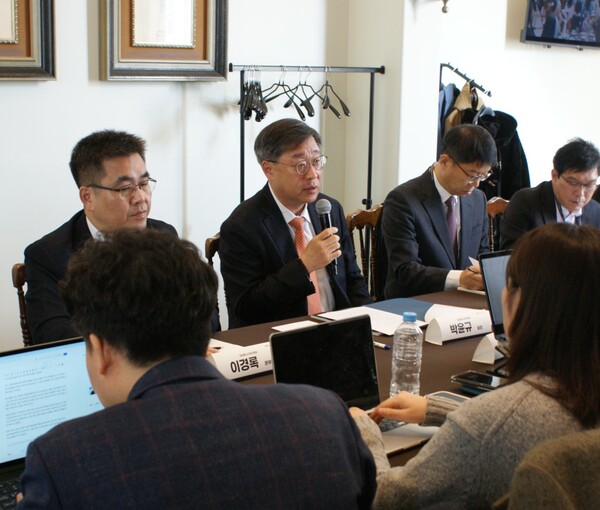
NIPA held a press briefing on Nov. 26 at the Raum Art Center in Seoul's Gangnam district. It shared these points along with this year's results in major AI support projects and the future direction of its programmes.
Fairness to be strengthened in third evaluation of domestic AI foundation model project, possible score-weighting changes
With the third-stage evaluation of the domestic AI foundation model project due in early next year, NIPA is focusing on improving how it evaluates candidates.
In the second-stage evaluation in August, Motif Technologies was eliminated despite receiving the highest score in the Artificial Analysis Intelligence Index (AAII), a global AI performance indicator. The outcome sparked controversy over the fairness and transparency of the evaluation.
Motif Technologies ranked first among four shortlisted teams with 24.6 points in a combined score from AAII and a benchmark evaluation by the National Information Society Agency (NIA). It ranked last in both expert and user evaluations and did not advance to the next stage.
SK Telecom, Upstage and LG AI Research advanced to the third stage. Motif Technologies raised objections, calling for disclosure of how benchmark scores were calculated and the criteria for expert evaluations. The Ministry of Science and ICT said evaluation criteria were set through consultations among the shortlisted teams and disclosed detailed scores by category.
NIPA plans to focus on resolving fairness disputes in the third evaluation. Moon Jang-won (문장원), head of NIPA's AI Utilisation Division, said the framework for upcoming evaluations has been decided. He said it would be similar in broad terms to the existing approach, but that NIPA had consulted shortlisted teams and various experts and considered ways to address issues that had been pointed out.
NIPA plans to maintain an evaluation method that uses global AI model performance indicators and to conduct more in-depth expert evaluations. It will also improve the evaluation system to ensure evaluators' neutrality in the user evaluation process. It left open the possibility that the weighting of points by evaluation category could change.
Park Yoon-kyu (박윤규), head of NIPA, stressed that agreement among participating companies is an important factor in securing fairness. Park said it is not easy to have perfect evaluation criteria. He said NIPA is making steady efforts to create criteria that participating companies can accept.
Park added that blind evaluations were also agreed, but that issues had been raised. He said NIPA is seriously discussing how to address the points highlighted.
AI for All to strengthen guardrails, foster AI agent ecosystem
In the 'AI for All' project, which supports public access to AI services, NIPA is focusing on setting safeguards to minimise side effects such as risks related to personal data protection and security. Three consortiums are participating in the project: SKT, Kakao and KT.
The consortiums are jointly discussing measures to manage risks that could arise in operating the service, including personal data protection, security and AI guardrails, NIPA said. Park said the service is expected to be used by the public and that he expects the three platforms to present strengthened security measures.
NIPA plans to develop AI for All into a platform that various AI companies can join rather than a simple AI chatbot service. Next year, it plans to establish a structure that allows external AI agents to be linked to the AI for All platform.
Examples include notification services that guide people through public benefits and AI agents for everyday services such as KTX train bookings. NIPA is also looking into the possibility of linking it with its public AI transformation (AX) programme.
Park also shared his reflections on NIPA's activities and the AI industry this year. He cited securing AI infrastructure, including graphics processing units (GPUs), as a key achievement. He suggested that AI should move beyond assisting with routine tasks and lead to meaningful productivity gains and value creation.
Park said many countries around the world view South Korea as a major country that will lead the AI era and are also seeking it as a cooperation partner. He said South Korea's AI environment also seems to have risen to a global level in terms of AI use.
He added that he hopes AI for All will be firmly established so that the public can use AI comfortably. He said he hopes it will become a platform that leads industrial development beyond being a platform used routinely by the public.
From AI infrastructure to overseas expansion, NIPA shares full-stack support results
NIPA will hold 'NIPA Scale-up Together 2026' for two days starting on Nov. 26. Now in its fourth year, the event shares results of AI and CT support programmes and provides opportunities for domestic companies to attract investment and expand globally.
This year, it expanded the event by adding an integrated results briefing, an AI agent results briefing and an overseas expansion strategy briefing, alongside its existing investor presentations and business consultations.
At the integrated results briefing, it will share results on the government's securing and use of GPUs, creating a domestic neural processing unit (NPU) ecosystem, and cases of AX applications in industry and the public sector. It will also introduce results in training field-oriented AX talent, regional AX programmes and fostering physical AI.
At the AI agent results briefing, eight companies participating this year in the AI agent convergence and diffusion support programme, including Wisnut, EoniCom and Saltlux, will present results from developing and validating AI agents by sector, including finance, manufacturing, media and semiconductors.
On Nov. 27, it will hold investment presentations by 16 promising AI and ICT companies and briefings on next year's company support plans by overseas hubs. An awards ceremony will also be held for 35 companies and organisations that achieved results through this year's support programmes.
 Jin-ho Lee
jhlee26@d-today.co.kr
Keyword
#NIPA #AI for All #Ministry of Science and ICT #SK Telecom #AAII
