
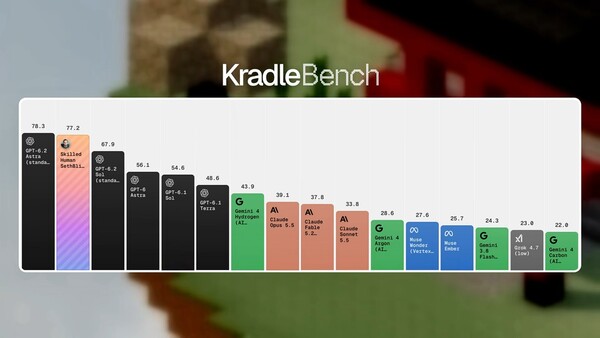
In a performance evaluation where AI competes in a real-time changing virtual world against humans, OpenAI took the upper hand. Still, skilled humans were found to remain far ahead of AI in areas requiring instantaneous judgement and strategic responses.
On Nov. 25, Japan's Gigazine reported that OpenAI's GPT-6.2 Astra took the overall top spot on KradleBench, a Minecraft-based multi-agent benchmark released by AI research institute Kradle (Kradle).
Unlike existing benchmarks that solve static problems, KradleBench is designed for multiple AI agents to cooperate or compete in a real-time changing virtual environment. It evaluates five areas: collaboration, resource gathering, combat and survival, logical thinking and creativity.
According to the latest official leaderboard, GPT-6.2 Astra scored 78.28 out of 100. Minecraft specialist gamer SethBling (세스블링) placed second with 77.21, a gap of just 1.07 points. GPT-6.2 Sol scored 67.93 to take third, while Google Gemini 4 Hydrogen and Anthropic Claude Opus 5.5 ranked seventh and ninth with 43.90 and 39.12, respectively.
In the detailed assessment, the strengths of humans and AI diverged clearly. SethBling ranked first in resource gathering and combat and survival, scoring 100 and 90, respectively. By contrast, GPT-6.2 Astra scored 100 in both logical thinking and creativity.
Kradle assessed the OpenAI model's strong performance as stemming from a balance between reasoning ability and response speed. While the Anthropic model tended to execute strategies after thinking for a long time, the OpenAI model continually adjusted its strategy in line with changing situations.
In the case of Google Gemini 4 Carbon, there was also an instance in which it drowned while thinking about how to escape after falling into water.
The results show that for AI agents to be used in dynamic environments such as real work or robot control, rapid situational judgement and the ability to revise strategy are important as well as reasoning. Kradle plans to expand evaluation tasks and compare performance across more human participants and AI models.
 Choi Jae-won
ittt_0801@d-today.co.kr
Keyword
#OpenAI #GPT-6.2 Astra #KradleBench #Minecraft #SethBling
