
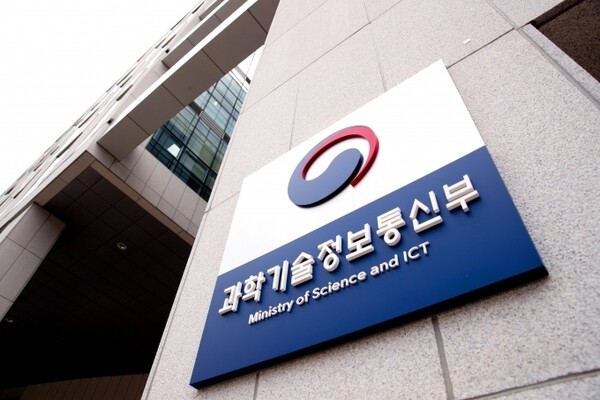
South Korea's Ministry of Science and ICT and the Korea Internet & Security Agency (KISA) on Wednesday held the first integrated awards ceremony for the Post-Quantum Cryptography (PQC) Transition Competition and Hackathon and presented certificates and prize money to 10 teams for strong results.
Post-quantum cryptography uses complex mathematical structures, such as lattice- and hash-based schemes, to make decryption difficult even for quantum computers. Converting existing cryptographic systems to post-quantum cryptography requires resolving various technical challenges, including system compatibility and performance.
The ministry held the competition and hackathon for the first time this year to identify ideas and technical capabilities needed for a post-quantum cryptography transition. A total of 161 teams applied to participate across the student and general categories.
The competition proceeded by having teams propose solutions to post-quantum cryptography transition issues in industrial settings. Participating teams presented solutions to problems arising in various environments, including crypto asset identification and analysis, migration of legacy systems, and Internet of Things (IoT) device authentication.
The hackathon held a technical contest to convert a virtual work system's existing cryptographic scheme to post-quantum cryptography. Participating teams implemented post-quantum cryptography-based communications and authentication while maintaining existing work functions and verified normal operation.
In the competition, Hansung University's Schdingkey team won the grand prize. The team proposed a way to cut data traffic by about 73 percent in the IoT device authentication process compared with applying post-quantum cryptography alone.
In the hackathon, Kakao Pay employee Moon Ji-won (문지원) won the grand prize after succeeding in the post-quantum cryptography transition for all five tasks in a virtual service environment and verifying the results with a self-developed tool. The ministry presented a total of 10 certificates and 12 million won in prize money to 10 teams, including the grand prize winners.
The ministry will review ways to apply ideas and technical achievements identified through the event to a pilot post-quantum cryptography transition project by industry. It also plans to use them in training programmes for professional talent.
Choi Woo-hyuk (최우혁), director general for information security and network policy at the ministry, said he hopes the ideas identified and participants' capabilities can contribute to private-sector transitions to post-quantum cryptography. He said the ministry will actively support efforts so that private-sector work can bear fruit in the field by building a solid industrial ecosystem.
 Lee Jin-ho
jhlee26@d-today.co.kr
Keyword
#Ministry of Science and ICT #Korea Internet & Security Agency #post-quantum cryptography #Hansung University #Kakao Pay
