
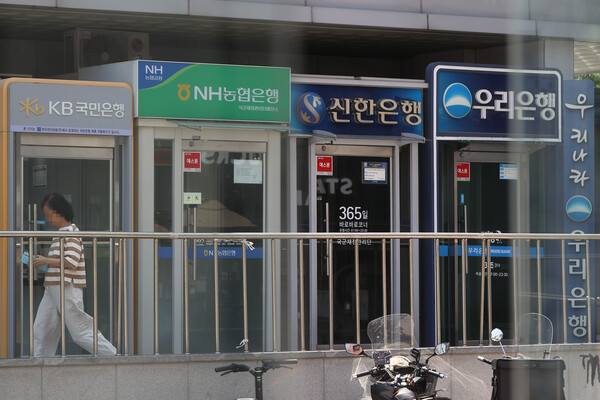
Financial authorities will introduce a new inclusive finance product that provides mid-to-low credit borrowers with unsecured loans at an average annual interest rate of around 10 percent through cooperation between banks and savings banks. The aim is to lower rates by about 3 to 5 percentage points compared with existing savings bank loans. The authorities also plan to ease soundness regulations that hinder financial companies from expanding lending to mid-to-low credit borrowers, with the goal of building a sustainable inclusive finance system.
The Financial Services Commission on Wednesday held the 8th Inclusive Finance Transformation Meeting chaired by FSC Chairman Lee Eok-won (이억원) and discussed rationalising soundness regulations in the financial sector, joint bank-savings bank on-lending loans and a plan to disclose performance in managing delinquent personal debt.
Lee stressed the need to build an institutional foundation that enables the financial sector to supply inclusive finance on an ongoing basis beyond one-off support, saying that this year’s expanded supply of inclusive finance has lowered borrowing costs for low-credit borrowers and increased outstanding loan balances.
An analysis by the Credit Information Service showed the average interest rate on unsecured bank loans to low-credit borrowers fell 0.05 percentage points to 8.63 percent a year from 8.68 percent between end-March and end-July. Savings banks also lowered rates by 0.27 percentage points to 15.07 percent from 15.34 percent. Over the same period, outstanding unsecured loans to low-credit borrowers in the financial sector rose by 1 trillion won, from 83.1 trillion won to 84.1 trillion won.
BANK-SAVINGS BANK JOINT ON-LENDING LOANS; LAUNCH EYED IN Q1 NEXT YEAR
The key measure is an "inclusive on-lending loan" that combines banks' low funding costs with savings banks' screening capabilities for mid-to-low credit borrowers.
Under the structure, banks provide funds to savings banks, which then use the funds to make loans to mid-to-low credit borrowers. It is designed to reduce banks' post-loan management costs associated with direct lending and enable savings banks to raise funds at lower cost, bringing down the final lending rate.
Eligible borrowers are those with annual income of 40 million won or less, or those with annual income of 50 million won or less who are in the bottom 20 percent by credit score. Interest rates will be set autonomously by banks and savings banks, but the plan is to operate the product at an average annual rate of around 10 percent. The FSC expects rates to be about 3 to 5 percentage points lower than existing savings bank unsecured loans.
The FSC will recruit participating operators from the end of this month and grant regulatory special cases, including under the Banking Act, through a planned regulatory sandbox. After designation as an innovative financial service early next year, it will seek to launch the product within the first quarter.
For participating banks, the FSC also plans incentives such as recognising on-lending loans as performance in supplying Sae Hee-mang Holssi loans and exempting them from payments of contributions to the Credit Guarantee Fund, the Technology Guarantee Fund and regional credit guarantee foundations.
RATIONALISING 9 SOUNDNESS REGULATIONS; SEMIANNUAL DISCLOSURE OF DELINQUENT DEBT MANAGEMENT PERFORMANCE
It also plans to improve soundness regulations to expand inclusive finance. The FSC and the Financial Supervisory Service have prepared a total of nine rationalisation tasks for banks, insurers, savings banks and specialised credit finance companies.
First, it will lower the risk weight applied to guaranteed loans backed by the Small Enterprise and Market Service from 20 percent to 0 percent. It will also pursue a plan to approve banks' alternative credit evaluation models as regulatory models so they can be used for calculating capital ratios and loan loss provisions.
For loans that underwent internal debt restructuring, it will cut the required repayment period for classification as normal loans from one year to six months if certain conditions are met. It will also ease standards for judging signs of distress in savings bank loans to individual business operators. Even if borrowings exceed annual sales, the loan will not be classified as a loan requiring attention based on that standard alone if net losses did not occur for two consecutive years.
The regulatory changes will be implemented within the first quarter next year after revisions and interpretations of supervisory regulations and detailed enforcement rules.
 Ji-young Lee
ljy@d-today.co.kr
Keyword
#Financial Services Commission #Financial Supervisory Service #Credit Information Service #Credit Guarantee Fund #Technology Guarantee Fund
