
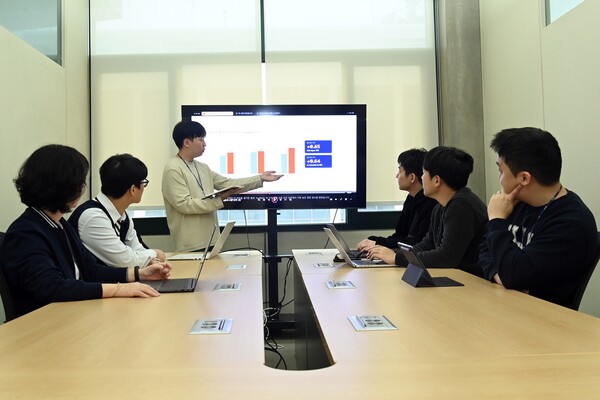
A South Korean research team has developed an autonomous research AI that carries out tasks on its own from selecting a research topic to writing a paper.
The Electronics and Telecommunications Research Institute (ETRI) said on Wednesday it has developed an autonomous research AI agent called YouRA.
YouRA determines the research direction and topic on its own when given a call for papers for an international AI conference workshop. It establishes a hypothesis after discussion and review by multiple AI agents, then carries out the full research process, including analysing prior studies, securing data, conducting experiments and verification, and writing the paper.
Existing autonomous research AI could miss records of failed hypotheses or experiments when the research process relies on chat logs. This could lead to cases in which actual experimental results do not match claims in a paper.
ETRI developed a technology that improves research reliability by managing the full research process as structured records and conducting step-by-step verification and analysis of failure histories. It separated the AI that conducts the research from the AI that determines whether each stage is completed, reducing the problem of hastily ending research with insufficient verification. Even if a researcher changes the research scope or evaluation criteria mid-way, the system can record the change history and continue the research.
ETRI verified YouRA's performance using the international public benchmark MLR-Bench. The comparison targets were Japan's Sakana AI's AI Scientist-V2 and the National University of Singapore's MLR-Agent.
In an evaluation of research ideas and plans, there was no clear difference from MLR-Agent, but in an evaluation of completing an actual paper, it recorded a higher overall score than the two comparison technologies.
YouRA's average overall score was 0.64 points higher than AI Scientist-V2 and 0.85 points higher than MLR-Agent. In a head-to-head evaluation comparing the papers written, it led MLR-Agent by 72 wins, 33 draws and 15 losses, and AI Scientist-V2 by 55 wins, 38 draws and 27 losses. Papers judged to have conducted experiments based on actual data totalled 27 out of 30, more than AI Scientist-V2 with 17 and MLR-Agent with 11.
Hallucination errors checked directly by humans were significantly fewer than MLR-Agent, but there was no clear difference from AI Scientist-V2. The overall score in the paper-completion evaluation was also in the 4 to 5-point range out of 10, a level requiring further technological advancement.
ETRI plans to expand the technology to various AI agents where work histories and evidence verification are important. It is also applying related technology to an AI tutoring agent that uses smart glasses to guide Korean speaking in real time.
Soo-jong Lim (임수종), head of ETRI's Language Intelligence Research Laboratory, said, "It is important for AI to conduct research on its own, but it must be possible to trust the process and the results for it to develop into a true AI scientist." He added, "We will advance the autonomous research and verification technologies secured this time and expand them to various science and technology fields such as new materials."
The research results were presented this month at the international academic conference AACL-IJCNLP 2026. ETRI also released YouRA's source code as open source.
 Jin-ho Lee
jhlee26@d-today.co.kr
Keyword
#ETRI #YouRA #MLR-Bench #AI Scientist-V2 #MLR-Agent
