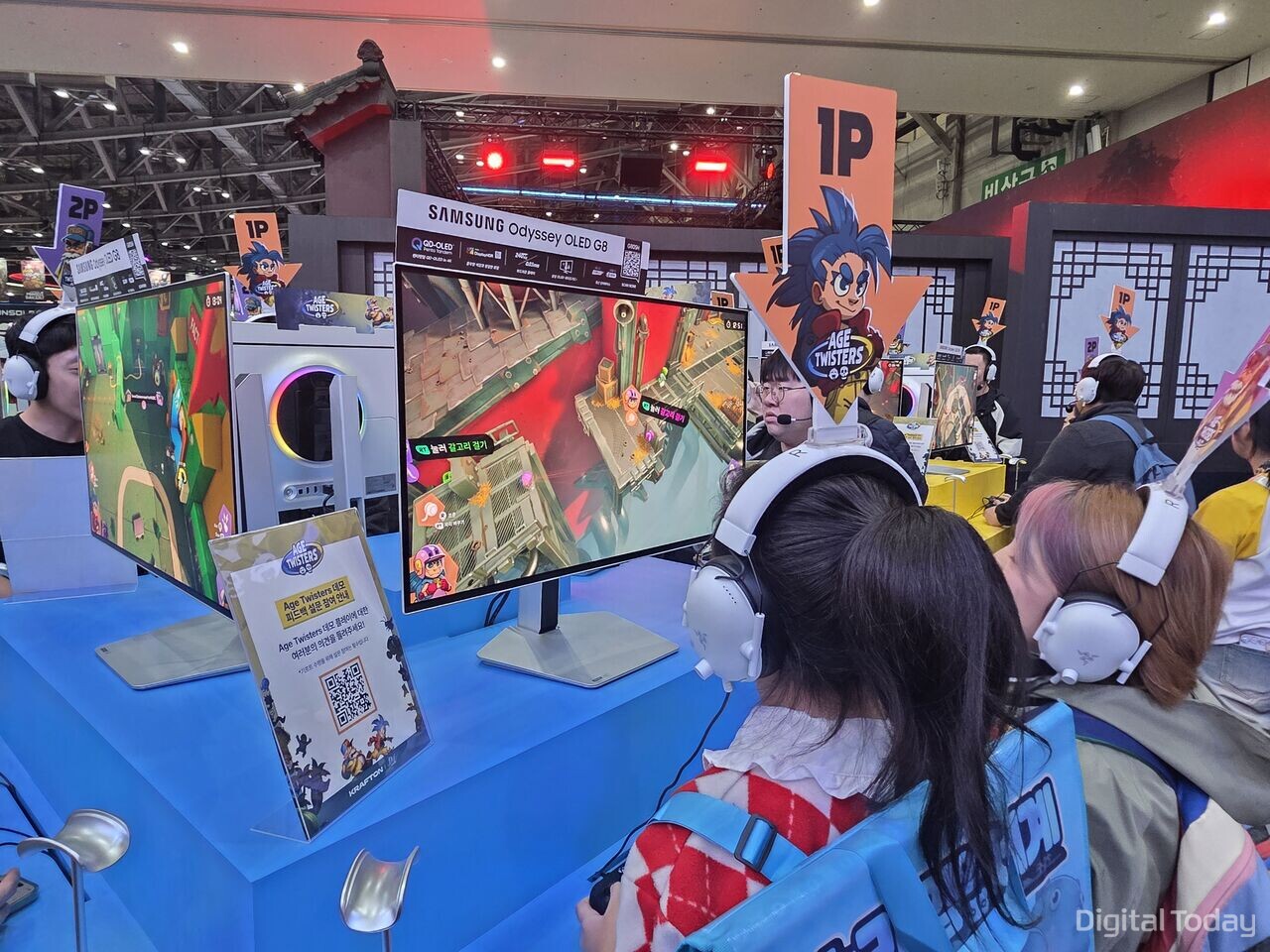
[Busan=Digital Today reporter Ho-jung Lee] For parents worried about seeing their children absorbed in games, consider sitting beside them and playing together instead of telling them to stop. Krafton's new title Age Twister, presented at G-Star 2026, shows the possibility of family communication through games.
Ahead of G-Star 2026, which opened on Nov. 19 at BEXCO in Busan, I tried Age Twister firsthand. During about 30 minutes of play with another participant, the most striking part was not flashy action or graphics. The game’s core fun lay in the process of two people putting their heads together to solve problems.
Age Twister is a two-player co-op adventure game developed by Barcelona-based Piccolo Studio and published by Krafton. It tells the story of a grandfather and granddaughter who set out on an adventure to find traces of a mother who disappeared long ago.
The game begins when a mysterious box arrives on the granddaughter’s 18th birthday. Inside are a letter left by her mother and a mysterious bracelet that can change the wearer’s age. Using the bracelet’s power, the two protagonists overcome various obstacles as they track the mother’s whereabouts.
Age is ability: Puzzles that require two players to put their heads together
The game’s most distinctive element is that it uses “age” as a tool for solving puzzles. Players can freely switch characters among four age stages: childhood, adolescence, young adulthood and old age.
It is not just a change in appearance. In childhood, the character can move quickly or swap positions with another object. In adolescence, the character uses an instrument to slow the movement of enemies or objects. In young adulthood, the character attacks enemies and obstacles with powerful punches. In old age, the character can move metal objects with magnetic force.
The interesting part is that no single age stage is always advantageous. When strength is needed, young adulthood is useful, but when players must retrieve a distant object, an old-age ability is required. Some sections are also difficult to pass without a child’s abilities.
This was clear in actual play. A puzzle involving crossing between buildings was particularly memorable. It was not simply about jumping or avoiding obstacles. Players had to take multiple steps, such as swapping positions with a chicken to move to the other side and then switching places with the other player, before they could reach the next section.
At first, I was flustered because I did not know what to do. Even though the path was visible, it did not come easily how to cross. But as I examined surrounding objects and used the abilities of each age stage one by one, ways to solve it gradually began to emerge.
Finding the solution was not the end. One person had to move first while the other used an ability from the right position, meaning roles and the order of actions had to align. No matter how good one person was at controlling the character, the puzzle could not be cleared unless the two were in sync.
That process came across as Age Twister’s biggest attraction. There was fun in identifying the gimmicks hidden in each stage and combining abilities suited to the situation to find a solution. Some sections were confusing at first because it was hard to guess what to do, but the sense of accomplishment was strong when a hidden gimmick was discovered after repeated attempts.
Above all, conversation naturally increased. Lines such as “Come over here,” “Let’s switch places this time,” and “Wait a moment,” kept coming. Players had to watch what the other was doing, and sometimes helping the other took priority over their own actions. It drove home that this was not a game about doing well alone, but about finding answers together.
Bridging the generation gap through games: A reason to play with family
That experience led to the thought that Age Twister is well suited for families or couples to enjoy together.
Assume a child who is used to games plays with a parent who does not know much about them. The child can teach the controls and the parent can add ideas for solving puzzles. Conversely, a parent can solve a problem the child finds difficult. That is because not everything is decided by game skill alone.
It is also meaningful in that parents cooperate with their children toward the same goal instead of controlling games one-sidedly. The process of different generations sharing opinions over a single problem can naturally become a reason to talk. The same applies to couples or friends playing together.
The developers also intended this experience. Krafton explained at a pre-event presentation that Age Twister was created to invite into games “people who sit at the same table but have never played a game together even once.”
The game also consistently explores the theme of generation gaps. Not only do usable abilities change depending on the character’s age, but dialogue in the same situation also changes. It effectively includes the message that “every age has its own value” in both the game system and the story.
Still, it was hard to say it is a game anyone can easily enjoy from the start. Despite cute characters and a bright atmosphere, the puzzle difficulty was higher than expected. The early stages progressed relatively smoothly, but later sections required combining multiple abilities, and some demanded precise control and timing.
In particular, users unfamiliar with gamepads may struggle with changing ages and aiming at objects. Because cooperation is central, if one side is not comfortable with the controls, the other player also has to wait. To secure a broad base of family users, control convenience is likely to be an important task before the official release.
Even so, Age Twister’s ideas and game structure were attractive enough. Its creative concept of integrating abilities from different age stages into puzzles and a structure designed so players cannot move forward without cooperating stood out. I want to give it high marks for valuing the process of solving together over doing well alone.
Age Twister is scheduled for release in 2027 on PC, PlayStation 5, Xbox Series X|S and Nintendo Switch 2. It supports local and online co-op play, and it also plans to offer a “Friend Pass” that lets one purchaser invite another person for free.
It is difficult to judge the game’s overall completeness based on only about 30 minutes of play. But after finishing the session, I felt I wanted to play it with my family.
It may not be able to resolve generational conflict around games at once, but it could create an opportunity to understand each other. That is the possibility shown by Age Twister, a game that is more fun when two people play together than when one plays alone.
 Ho-jung Lee
lhj@d-today.co.kr
Keyword
#G-Star 2026 #Krafton #Age Twister #Piccolo Studio #BEXCO