
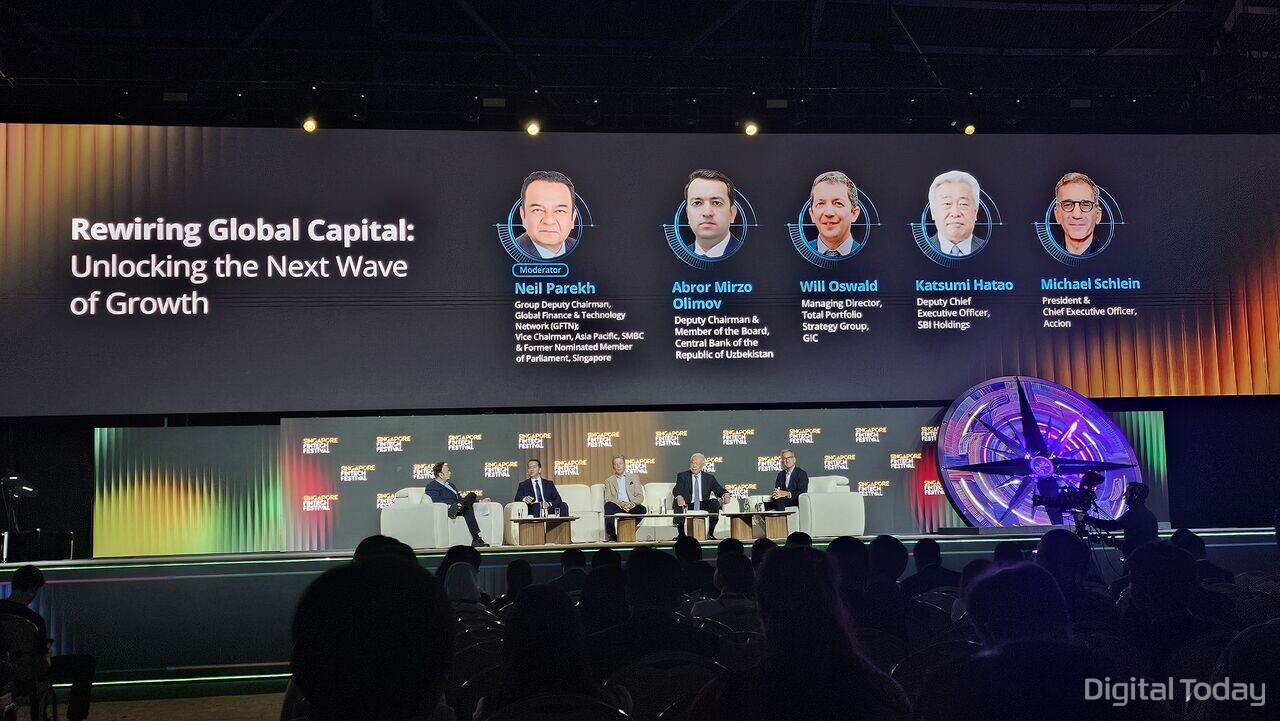
Global financial markets are seeing investment concentrate in AI-related areas, and major institutional investors warned of risks from capital concentration and stressed changes in investment strategy. They also said stablecoins, blockchain and financial infrastructure innovation using AI are emerging as new investment opportunities.
A global investor panel discussion at the Singapore FinTech Festival (SFF 2026) held at Singapore Expo on Nov. 20 covered risks from concentrated AI investment, global capital allocation strategies and the expansion of cross-border financial services using digital assets as key agenda items.
The discussion was attended by Will Oswald (윌 오스왈드), managing director at Singapore sovereign wealth fund GIC; Katsumi Hatao (가쓰미 하타오), vice president at Japan's SBI Holdings; Michael Schlein (마이클 슐라인), CEO of Accion; and Abror Mirzo Olimov (아브로르 미르조 올리모프), deputy governor of the Central Bank of Uzbekistan. Neil Parekh (닐 파레크), vice chairman of the Global Finance & Technology Network (GFTN), moderated.
AI concentration under scrutiny... concerns also raised over a bubble in Anthropic listing
Oswald said investors could be exposed to risks they do not anticipate as AI-related investment increases across various financial products such as stocks and bonds.
"Three to four years ago, if you wanted to invest in AI, you could choose the shares of related companies, but now AI is affecting all investment areas including equities, private investments, bonds, credit and infrastructure," he said.
He stressed that it is important to identify where AI-related risks exist in a portfolio and manage them as independent risk factors.
Schlein also voiced concern about capital and wealth concentrating in a small number of AI companies.
He cited the AI company Anthropic, which listed on the Nasdaq in the United States on Nov. 19. Anthropic drew strong global investor interest, with a market value of about $175.0 billion based on its first-day closing price.
"Anthropic's case may succeed, but it is a big risk for enormous wealth to concentrate in a handful of advanced AI companies including OpenAI," Schlein said.
He also said potential risks from the development of AI technology are not sufficiently reflected in financial markets. AI experts have raised the possibility of large-scale technical accidents, but investors are not properly assessing those risks, he said.
The panel also pointed to global capital demand concentrating in specific areas.
"There are three huge entities standing in a single queue right now," Oswald said. "They are governments, AI and energy." He said GIC is reshaping its portfolio management approach that has focused on traditional asset classes to respond to that environment.
"In the past we separated listed equities, private investments and bonds, but now we approach based on the characteristics of investment risk and returns such as growth, profit generation and inflation protection," he said.
He also said there is no need to necessarily see an IPO as the point of investment exit. For long-term investors, an IPO can be an intermediate step in a company's growth process rather than the end of an investment, he said.
SBI expands global payment network using stablecoins
Japan's SBI Holdings presented building cross-border payment infrastructure using blockchain and stablecoins as a new growth opportunity.
Hatao pointed out that the existing financial system is fragmented by country-specific regulations and infrastructure, and stressed the importance of connecting through digital assets.
"The essence of finance - trust and the transfer of value and risk management - does not change, but the way finance reaches people is changing," he said. "Each time infrastructure changes, finance becomes cheaper, faster and easier to access."
SBI currently operates businesses related to banking, securities, insurance and digital assets in 26 countries and regions. It aims to connect those businesses into a single global financial network using digital assets, rather than leaving them in individual markets.
Hatao also introduced an overseas trade settlement case using stablecoins. He said it previously took 3 to 5 days and incurred fees of up to 4 percent for a Japanese trading company to remit funds to Africa, but using stablecoins made same-day settlement possible.
SBI said it is also pushing to build similar stablecoin-based trade settlement systems in South Korea, Singapore and Cambodia, among other places.
It is also working with Cambodia's central bank to pursue tokenisation of government bonds and introduced measures to increase individual investors' access to government bond investment through blockchain-based payments.
"Companies that build interoperable infrastructure connecting traditional finance and decentralised finance across borders will secure competitiveness," Hatao said.
AI expands access for the financially excluded... investment opportunities emerge in emerging markets
The possibility of expanding inclusive finance using AI technology also emerged as a key topic. Schlein said social value and investment profitability can coexist in inclusive finance.
Accion is a global non-profit organisation that invests in and supports the growth of companies providing financial services to the financially excluded. Schlein said Accion has so far invested in or supported the growth of 299 financial services companies in 77 countries.
"In some impact investment areas such as health, education and clean water, there is a trade-off between social impact and profitability, but that is not the case in fintech for inclusive finance," he said. "Among the companies we have invested in, those that create the greatest social impact sometimes also show the highest profitability."
He highlighted that AI can drastically lower the cost of providing services to the financially excluded. He said that even in rural areas with low financial access, AI can provide crop-specific agricultural information, local weather and subsidy information tailored to an individual's budget and local language.
"AI can greatly lower the cost of reaching people who have been excluded from financial services and improve the quality of the services provided," Schlein said. He said technological development is expected to lead to the expansion of inclusive finance and new investment opportunities.
Uzbekistan announced a strategy to attract foreign capital through financial market reform and fostering its fintech industry.
"In Uzbekistan, fintech is not a new separate industry but the future of the financial system," Olimov said. "We are pushing financial industry innovation as a core part of the national growth strategy."
The Central Bank of Uzbekistan plans to attract more than $1.0 billion in foreign direct investment in fintech by 2030 and expand the number of fintech companies to more than 200.
Participants agreed that the spread of AI and digital assets is changing the investment structure of the traditional financial industry. They stressed the need to manage the risk of capital concentration from technological innovation while also finding new growth opportunities in cross-border financial infrastructure and inclusive finance.
 Lee Ji-young
ljy@d-today.co.kr
Keyword
#Singapore FinTech Festival #GIC #SBI Holdings #Anthropic #Uzbekistan
