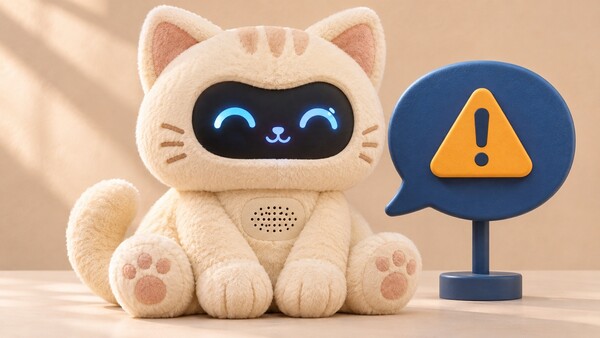
Some AI-equipped toys for children have become embroiled in a safety controversy after giving inappropriate answers and providing inaccurate information. Major U.S. retailers have halted sales of some products, and concerns are also growing about how AI toys affect children's emotional development and personal data protection.
Business Insider reported on Nov. 19 that major U.S. retailers including Target, Walmart, Macy's and Amazon have recently deleted sales listings for the AI toy Contixo AI Pixie-Paw after safety issues were raised.
The product is a cat-shaped stuffed toy sold for children aged 3 and older. It has a display in the eye area and can talk with users using AI. The manufacturer promoted storytelling, learning and safe role-playing as key functions.
But a test by NBC News in the United States revealed serious problems. When reporters asked the doll about historical events such as the Rohingya genocide and the 1940 Katyn massacre, it explicitly described sexual violence and execution processes.
Errors were also found in other AI dolls tested at the same time. One product switched between English and Chinese in its answers, and another promoted as suitable for supporting autistic children and teaching toddlers spelling could not correctly write even a basic word like "apple."
This is not the first time safety problems have been raised about AI toys for children. U.S. consumer group Public Interest Research Group (PIRG) pointed out last year that some AI toys respond to sexual conversations or provide dangerous information.
Problems continued this year. In its "Trouble in Toyland 2026" report released on Nov. 17, PIRG said it confirmed signs that safety devices in some AI toys weaken as conversations get longer. Some products even provided sexually inappropriate content or explanations of dangerous actions.
Service continuity is also cited as an issue for AI toys. The children's social robot Moxie, previously sold for $800, had its service support discontinued due to its developer's financial difficulties. Some children were reported to have complained of a sense of loss after the robot they had formed a bond with stopped working.
Moves are also emerging in countries to strengthen child protection. In the United States, a bill has been introduced to investigate risks from AI toys for children and prepare response measures. In Britain, some lawmakers called early this month for a ban on sales of AI conversational toys, and the government is investigating the possibility that related products can generate inappropriate content.
The European Union is responding to related risks through its AI Act and toy safety rules. In particular, some toys that use AI for safety functions may be classified as high-risk AI systems, and internet-connected toys are also subject to cybersecurity and personal data protection requirements.
Regulatory moves are also continuing in major Asian countries. In South Korea, the AI Basic Act that took effect in January introduced obligations for prior notice and transparency for generative AI products and services. China in April announced rules on AI anthropomorphic interaction services and required guardian consent and minor protection functions when providing services to children under 14.
Experts acknowledge that AI toys could be used for language learning and practicing social skills, but warn of the risk that children may confuse relationships with AI and real humans. The American Psychological Association (APA) also listed emotional dependence, personal data protection and parental control functions as key issues for review in an analysis this month.
Critics say that as AI toys go beyond simple play tools to serve as conversation partners for children, it is necessary to consider not only content safety but also emotional impacts and problems after services end.
 Jae-won Choi
ittt_0801@d-today.co.kr
Keyword
#Contixo AI Pixie-Paw #Target #Walmart #PIRG #European Union