
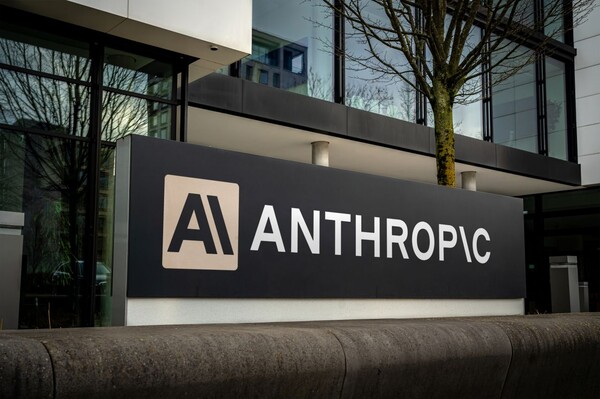
AI company Anthropic has completed what it described as the largest initial public offering on record and made a successful Nasdaq debut. The stock rose more than 17 percent above its offering price on the first day of trading, and buying interest is growing among Chinese retail investors. Some investors are split on the company’s long-term growth prospects given its high valuation and the rise of Chinese AI rivals.
The Hong Kong-based South China Morning Post reported on Nov. 19 that Anthropic began trading on Nasdaq under the ticker symbol ANT. The offering price was $83 a share, and the stock closed at $97.17, up about 17 percent from the IPO price. It surged as high as $111.50 in early trading, briefly lifting its market value above $2 trillion. Based on the closing price, its market value was put at about $1.77 trillion.
Anthropic offered a total of 980 million shares at $83 each in the IPO, raising about $81.3 billion. The price was above the initial indicated range of $70 to $78. The offering included about 956.4 million new shares and about 23.6 million shares held by existing shareholders. The listing surpassed SpaceX’s roughly $75 billion IPO five months earlier, making it the largest IPO on record.
Chinese retail interest has continued after the listing. Cecilia Yang (양), a 28-year-old consultant in Hangzhou, said she uses Claude for day-to-day work and wants to buy a small amount despite the high offering price. "The offering price is too high, but I want to support Claude and buy at least a little," she said. The experience of using AI services, as well as a company’s financial value, appears to be influencing investment decisions.
Mainland Chinese investors do not find it easy to buy Anthropic shares directly. Institutional investors in mainland China and Hong Kong are reported to face restrictions on subscribing to U.S. IPOs. Hong Kong retail investors can gain access after the Nasdaq listing through brokerages that support trading in U.S. stocks, but mainland retail investors face capital controls related to overseas securities investment.
Chinese investors living overseas have relatively easier access. Chris Cheng (청), a Beijing native living in the United States, subscribed for 10 shares of Anthropic through Robinhood’s IPO access program. He said it was difficult to get investment opportunities when the company was private and assessed that an IPO offers retail investors a chance to participate at the same price as institutions. He also said he would invest only within what he can afford.
Scepticism over the high valuation is also significant. Laura Huang (황), a retail investor in Shanghai, said demand for AI and computing is real but assessed that Anthropic’s valuation has been excessively inflated. She argued that the current value is difficult to justify given high computing costs and competition from cheaper open-weight models from China.
The spread of open-source and open-weight models is also a factor in the enterprise AI market. Robin Du (두), a retail investor in Shanghai, explained that companies that are reluctant to entrust sensitive data to outside providers prefer open models they can run on their own. He pointed to open-source models as competitive because they can sharply lower costs and allow companies to secure direct control over data.
Interest is also being driven by the fact that Anthropic’s services are not officially offered in mainland China and Hong Kong. The company restricts access from unsupported regions, but some users are using Claude through virtual private networks (VPNs). Actual usage, even when official access is limited, is translating into interest in buying the stock.
Some also voiced caution about the post-listing share performance. William Lee (리), a Chinese engineer in Sydney, forecast that the stock could rise in the early period after listing but could also fall sharply after three months. He cited the possibility that early investors taking profits could increase volatility.
In the global AI market, Chinese rivals are also stepping up their challenge. Bilal El Alami (빌랄 엘 알라미), founder and chief executive of Euronext-listed investment firm Pirax, analysed that AI competition is expanding beyond a battle between Anthropic and OpenAI into competition between closed paid models and open models that can be self-hosted. China’s DeepSeek and Kimi, and Europe’s Mistral, are cited as major rivals in the open-model camp.
French AI company Mistral said in August that it would begin external hosting of the open-weight model GLM-5.2 developed by China’s Zhipu AI. As demand grows in Europe and Asia for direct control over AI infrastructure and data, closed-model companies such as Anthropic could come under pressure in terms of costs and competitiveness.
Anthropic’s strong first-day performance shows investors’ high expectations for the AI industry. But analysis suggests it will need profitability, control of computing costs and technological competitiveness that outpaces rivals, including those from China, to continuously support a market value well above $1 trillion.
 Jinju Hong
hongjj@d-today.co.kr
Keyword
#Anthropic #Nasdaq #Claude #South China Morning Post #VPN
