
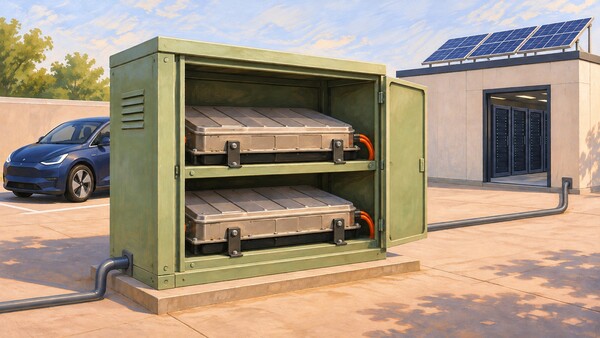
Electric vehicle batteries that have reached the end of their life are drawing attention as a new power storage option for AI data centres. U.S. battery recycling company Redwood Materials is expanding a business that reuses used EV batteries as energy storage systems (ESS).
Business Insider reported on Nov. 19 that Colin Campbell (콜린 캠벨), chief technology officer at Redwood Materials, said in an interview, "There is a possibility that the battery-reuse-based energy storage business could grow larger than the existing recycling business."
Redwood Materials was founded in 2017 by Tesla co-founder J. B. Straubel (J. B. 스트라우벨). It grew mainly through recycling that recovers key minerals such as lithium and nickel from discarded batteries, but has recently expanded its business with a strategy of first using batteries that remain usable for power storage.
The company sees that even retired EV batteries can be reused at data centres or factories if they retain sufficient energy storage capacity. After their storage capacity declines, the batteries are dismantled to recover key minerals.
Campbell said, "Surging power demand from AI data centres has created new business opportunities." He said using existing EV batteries can allow energy storage facilities to be built relatively quickly at a time when connecting to the power grid can take years.
Redwood Materials built a microgrid in Nevada in June last year with 12 megawatts (MW) of output and 63 megawatt hours (MWh) of storage capacity. The facility combines solar power with used EV batteries to supply electricity to 4 modular data centres operated by AI infrastructure company Crusoe.
Redwood Materials said the facility recorded a 99.2 percent operating uptime after it began running. Based on that, the company is also pushing a project to additionally support 20 of Crusoe's data centres.
The company is also working to secure batteries needed for expansion. S&P Global said Redwood Materials recently secured about 40,000 to 50,000 used EV battery packs. That equals about 2 gigawatt hours (GWh) in storage capacity, and the company plans to double that over the next year.
It is also strengthening cooperation with automakers. With Rivian, it plans to build an energy storage facility of 10 MWh at a plant in Illinois using more than 100 used battery packs.
Not all of the secured battery inventory has been deployed in actual facilities. The company also needs technology to verify remaining life and safety by battery and to stably integrate products from different manufacturers.
Redwood Materials aims to secure new revenue sources by combining battery recycling and energy storage. As the power crunch at AI data centres intensifies, attention is focused on whether reuse of used batteries can grow into a new energy industry.
 Choi Jae-won
ittt_0801@d-today.co.kr
Keyword
#Redwood Materials #Colin Campbell #J. B. Straubel #Crusoe #Rivian
