
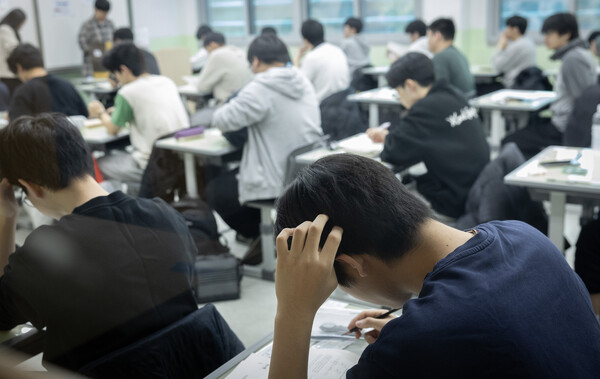
As AI technology reshapes even the scene of national exams, it is emerging as a threat in everyday life. That is because concerns over cheating using AI have spread to the College Scholastic Ability Test. Analysts say this year’s CSAT could be a turning point in how society recognises and responds to AI threats.
As of Nov. 19, the education and ICT industries say many attempts at AI-enabled cheating have already been caught in school exams and national qualification tests. A full survey by the Ministry of Education found 4 cases of cheating involving smart glasses in middle and high school exams this year. Smart-glasses use was also detected in last month’s early-admission essay tests at Yonsei University and the University of Seoul.
More recently, the top scorer on the tax accountant exam admitted to cheating using a tiny camera, a smartphone and generative AI and turned himself in to police. He said he photographed exam questions and checked answers with AI, according to his statement.
Beyond school and qualification tests, the CSAT too — confusion across test sites
As concerns spread over cheating by abusing AI, this year’s CSAT sites were put on high alert. The government implemented special cross-government measures ahead of the 2027 CSAT. Vice Education Minister Choi Eun-ok (최은옥) said at a briefing on Nov. 17, "The confusion our society faces when the CSAT is not administered strictly and fairly is worse than a disaster," adding, "We judge this is a situation that requires an excessive response."
Confusion continued even before the start of the exam. The Ministry of Education, a day before the CSAT on Nov. 18, limited writing instruments that students could personally bring and use to black pencils. At some pre-exam gatherings, teachers had to explain again because existing guidance videos differed from the revised instructions. Online training was also conducted in haste for additional proctors who were assigned.
On the test day on Nov. 19, about 8,400 additional personnel were deployed to 1,312 test sites nationwide, including about 75,000 proctors, about 1,800 staff dedicated to smart devices and about 6,600 corridor monitors. Proctors checked students’ glasses every period and put stickers on clothing buttons where tiny cameras could be hidden. They sweated through identity checks, collecting belongings and inspecting glasses and clothing within limited time.
The government also sent emergency disaster text alerts to identify those who did not submit mobile phones. The first alert was sent at 8:30 a.m. and 22 smartphones that had not been turned in were found in 9 cities and provinces nationwide. In the afternoon, a tiny camera and earphones were found at a CSAT test site in Yongin. In Cheonan, a student wearing smart glasses was caught by a test site administrator.
The confusion spread beyond test sites. The emergency alert tones that rang out nationwide startled people on subways and in offices. Controversy also arose over whether the messages were actually sent and received, as claims emerged that some did not get the alerts. One education industry official said, "The infection-prevention partitions we had during COVID-19 were nothing," adding, "The IT industry, the education sector and even ordinary citizens have all been swallowed by AI."
Detection technology development begins but blind spots remain — task of improving response system
The government and industry have begun developing advanced device detection technology, but blind spots remain. Smart glasses and tiny cameras are difficult to identify through visual inspection or existing radio-wave detection methods alone. The Korea Communications Agency has recently pursued a project to develop radio-wave detection equipment for AI smart glasses, and several private companies have also begun developing radio-wave detection devices.
The problem is that even with such efforts, it is difficult to completely block cheating that abuses AI. Smart glasses and tiny cameras have limits when relying only on visual inspection or existing radio-wave detection. Radio-wave detection makes it hard to catch "on-device AI" that performs AI computation within the device itself. Even if a wireless signal is captured, it must be separately verified whether the device was actually used for cheating.
The current monitoring approach, which relies on people, also has limits. In the earlier tax accountant exam case, proctors did not notice the cheating. As it becomes hard to distinguish appearances and methods emerge that combine cameras and communications equipment, it is difficult to catch 100 percent of cases with only a proctor’s eye. One industry official said, "The lifeblood of detection technology is performance verification across various devices and continuous technical improvement," adding, "We are in a situation where we cannot keep up with the pace of AI technological development."
The official also said, "For large exams like the CSAT, everything has to line up — the budget to supply devices, technicians to determine malfunctions, and security personnel to prevent information leaks," adding, "It is time to speed up development of hardware technology that prevents abuse, using this case as a lesson."
The government decided to strengthen follow-up measures. It said it plans to operate a reporting centre even after the CSAT ends and, if suspicious cases are confirmed, investigate by analysing scores and communications records. It is reviewing a plan to extend the current 1-year eligibility restriction period for CSAT cheaters to as long as 10 years. It is also pushing a plan to request investigations for serious cheating that abuses advanced devices.
But the industry’s general view is that tougher punishment alone will not prevent cheating. One industry official said, "Cheating using AI is not a problem limited to national exams," adding, "Similar risks could appear across areas that evaluate human ability, such as corporate interviews or private tests. That is exactly the kind of threat driven by AI."
 Jin-ho Lee
jhlee26@d-today.co.kr
Keyword
#CSAT #Ministry of Education #KCA #AI smart glasses #on-device AI
