
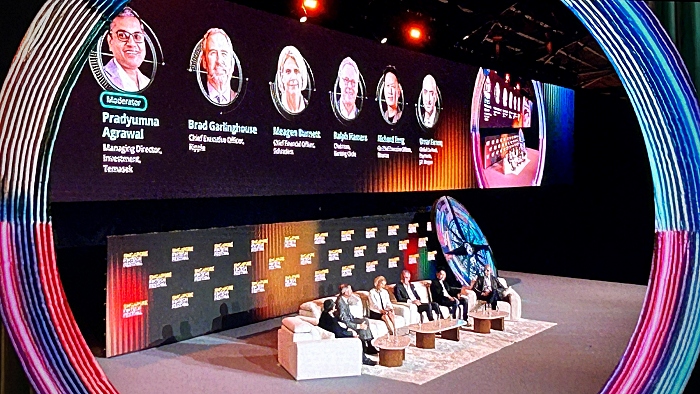
[Singapore=Digital Today reporter Hyunwoo Chu] Leaders from global finance and virtual asset companies including Ripple, Binance and JPMorgan discussed the future of cross-border payment rails on Wednesday local time at the Singapore FinTech Festival (SFF) 2026. They broadly agreed that stablecoins, tokenisation and existing bank networks will compete, but ultimately need to connect with each other.
■ Banks also use blockchain, but views differ on stablecoins
Ripple CEO Brad Garlinghouse (브래드 갈링하우스) said Ripple has more than 1,700 customers and stressed a one-stop offering that bundles stablecoins and custody services. He said the view that traditional finance and decentralised finance are separate is shifting to the concept of a bridge.
Umar Farooq (우마르 파룩), co-head of global payments at JPMorgan, said blockchain rails are addressing real demand. He said they provide instant foreign-exchange settlement for Asian payment service providers that are reluctant to prefund accounts. He also said energy companies use them when they need to post margin in local currencies outside U.S. market hours. He said transaction volumes on this B2B platform exceed $2 trillion.
Schroders CFO Meagen Burnett (메이건 버넷) drew a line at becoming a bank or issuing its own stablecoin. She said the company launched a tokenised money market fund for investors seeking yield, instead of non-interest-bearing stablecoins.
Binance co-CEO Richard Teng (리처드 텡) argued that stablecoins greatly reduce remittance costs for people in emerging markets who struggle to access banks. He said that after introducing tokenised stocks, 57 percent of U.S. stock trading took place after U.S. market hours, pointing to demand for 24-hour trading. On concerns about systemic risk, he said rules such as the GENIUS Act are in place.
A counterargument also emerged. Farooq said stablecoins are effectively concentrated in a single currency, the dollar, and that their strength is the absence of KYC burdens. He added that even if remittances are cheap, costs arise when converting them into local currency for use. Banking Circle Chairman Ralph Hamers (랄프 하머스) said true financial inclusion means joining a banking system that allows saving and lending, and that 99 percent of the real economy is still in fiat currency.
■ Rail fragmentation is driven by regulation and geopolitics
Hamers said fragmentation of payment networks stems not only from innovation but also from regulation, geopolitics and sovereignty issues. He said Banking Circle aims for neutral infrastructure that does not pick winners among rails. Citing McKinsey figures, he also said stablecoin payment volume has doubled over the past 2 years but remains only 0.02 percent of total fund flows.
Garlinghouse said innovation built around bank consortiums is hard to make work and will create opportunities for agile companies. Burnett said she was concerned that capital allocation focused only on speed could increase existing complexity.
The discussion session on Wednesday focused less on which side will win between stablecoins and bank networks than on how to connect them. With stablecoins still accounting for only a small share of payments, the assessment was that market outcomes hinge on interoperability that links rails divided by regulation and geopolitics while preserving trust. Some panelists also said they remained wary that a 24-hour automated market could be vulnerable to cyberattacks such as hacking.
 Hyunwoo Chu
cookinpapa@d-today.co.kr
Keyword
#Singapore FinTech Festival #Ripple #Binance #JPMorgan #GENIUS Act
