
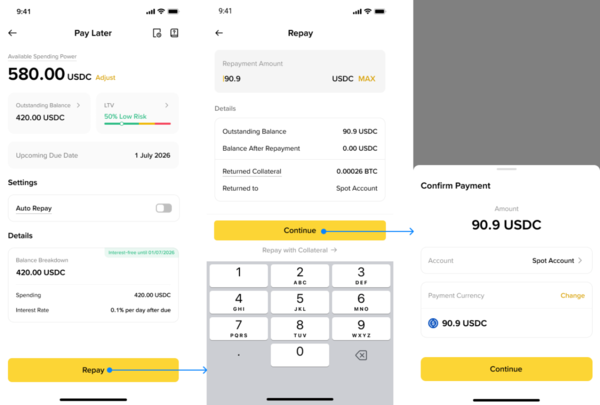
Binance will launch its Pay Later service in Argentina and Mexico, offering payment credit of up to 1,000 USDC backed by bitcoin, ether and BNB.
Cointelegraph, a blockchain media outlet, reported on Nov. 16 local time that users can receive a spending limit through Binance Card or QR Pay without selling their crypto holdings.
The service is designed to allow borrowing up to 50 percent of the value of assets accepted as collateral. To use the full 1,000 USDC limit, users need collateral in bitcoin, ether or BNB worth $2,000 (about 2.7 million won).
Payments are interest-free until the maturity date, and users can repay during a one-day grace period after the due date without interest or late fees. After that, unpaid balances incur daily interest of 0.1 percent, calculated on a compounded basis that also charges interest on interest.
Thomas Gregory (토머스 그레고리), vice president of payments and fiat at Binance, said traditional consumer loans rely on income verification and credit history, making them difficult to use even for people with assets but limited formal credit records. He said providing credit backed by held assets could be an alternative.
If the price of collateral assets falls, collateral may be liquidated regardless of a user's intentions. Binance stated it can liquidate even before the repayment deadline if the loan balance reaches 90 percent of the collateral value. That leaves liquidation risk from falling collateral prices even for interest-free buy-now-pay-later payments.
Binance plans to start the service for users in Argentina and Mexico and then gradually expand to other markets. The service is seen as an attempt to link crypto holders to payment demand outside the existing credit system. It also suggests users should weigh both access to credit and the risk of price volatility, given the possibility of forced liquidation if collateral value declines.
 Yoonseo Lee
yslee@d-today.co.kr