
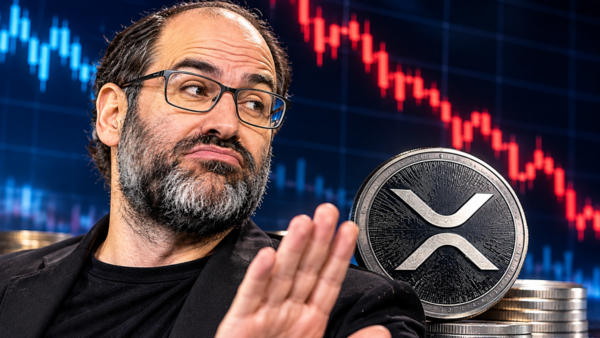
[DigitalToday reporter Jinju Hong] David Schwartz, a former chief technology officer at Ripple, disclosed that he reduced his XRP holdings by about 88 percent from their peak and pushed back against investor criticism. He also explained why he has sold portions during cryptocurrency price surges. He also released results from having an artificial intelligence model assess the XRP Ledger (XRPL) codebase, prompting debate among developers.
On Nov. 16 local time, blockchain media outlet U.Today reported that Schwartz posted a GIF using a scene from a Natalie Portman broadcast in response to criticism asking whether he should be viewed as a role model for cryptocurrency investors. He wrote: "I never said I was a role model."
Schwartz said he once held about 26 million XRP but now has about 3 million left. That represents a reduction of about 88 percent compared with the peak. He also said his bitcoin holdings fell to 1 from about 1,500, and his ether holdings fell to 6 from about 40,000.
He stressed that he is very risk-averse. He said he and his wife agreed long ago to sell portions of their holdings whenever cryptocurrencies hit all-time highs. He said he has maintained a strategy for years of using price rises as an opportunity to reduce risk exposure.
Schwartz said he sold about 2.5 million XRP in 2025 and paid about $1.7 million in capital gains tax related to the transaction. The XRP he sold was received in 2020 and 2023. He added that all sales were carried out under pre-documented trading plans and that each plan received a lawyer's approval at least 30 days before execution.
Schwartz said he previously did not easily trust rises in cryptocurrency prices. He said he thought the price was excessively high when XRP reached 10 cents and when ether rose to $1. He said he made a similar judgment when bitcoin reached $200.
Schwartz said the biggest risk asset for him is still his stake in Ripple. He said he sharply reduced his personal cryptocurrency holdings, but his exposure to the value of the stake tied to Ripple remains large.
On the XRP price, he assessed that it is currently influenced more by investment sentiment across the broader cryptocurrency market than by network fees. If a successful ecosystem is built in the future, XRP could absorb part of that value, he said, but he drew a line by saying he cannot guarantee it. As of Nov. 16, the XRP price was presented at $0.956.
Schwartz also disclosed on the same day the results of asking Qwen, an AI model from China's Alibaba, to evaluate the XRPL codebase. He said, "I asked Qwen to evaluate what I've done in XRPL software," and added, "Overall it was good, but some points were quite sharp and not wrong."
Qwen gave a positive assessment of XRPL's overall architecture but said coupling between some components is excessively high. It also cited as areas for improvement that a migration to a new testing framework was halted midway and that the code generation method lacks transparency.
In response, some XRPL developers said they are already rewriting some of the code that was flagged. Other users argued that formal verification of the XRPL core is needed before new features scheduled for 2027 are applied.
Separate from the controversy over Schwartz's XRP sales, the AI review results also renewed attention to the stability of the XRPL core infrastructure and its maintenance system. It means that not only cryptocurrency holding strategies but also the quality of the software underpinning the network and its verification procedures have emerged as key topics of discussion.
@hllywd22 @tchdwntommyd @WHTBOYRICKY @CryptoTaxFixer When XRP hit 10 cents, that seemed ridiculous. When ETH hit $1, that seemed ridiculous. What BTC hit $200, that seemed ridiculous.
 Jinju Hong
hongjj@d-today.co.kr