
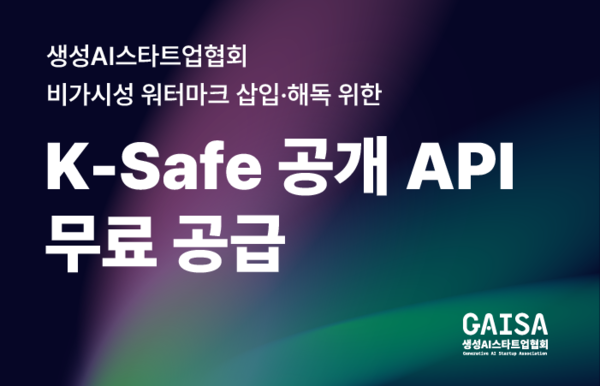
The Generative AI Startup Association said on Wednesday it will provide its “K-Safe open API for ensuring the reliability of generative AI” service free to domestic AI companies. The association said it aims to prevent the spread of deepfakes and help build a safe generative AI ecosystem, ahead of the AI Basic Act taking effect on Jan. 22.
The service is supported by member company Snaptag, which provides related technology and infrastructure. The association said it is designed as a public infrastructure that supports ensuring the reliability of generative AI content and verifying provenance, so AI companies can adopt it immediately without cost, infrastructure or security burdens, in line with the AI Basic Act’s aim of strengthening transparency.
The association will provide free of charge both an encoding SDK that inserts identification information into AI-generated output and a decoding SDK that checks whether the content was made using generative AI.
Companies can apply invisible watermarks by installing the SDK provided by the association in their services and linking it to the K-Safe open API server. Watermark insertion and verification for images or video are carried out in each company’s local environment through the SDK, and only authentication key information is exchanged with the public server.
The association stressed it also strengthened security by adopting a “Zero-Content” architecture that does not send original content to external servers.
The association plans to begin a beta service internally in January and, after a stabilisation process, fully open the service free of charge from April to all domestic AI companies and content platforms. It will be provided for free in South Korea as a trust infrastructure for public purposes, but the association plans to expand it in global markets into a paid enterprise service model to build a sustainable ecosystem.
Min Kyung-woong, Snaptag’s chief executive who is overseeing the project at the association, said, “What matters in an AI regulatory environment is not declarations but technology that can be applied immediately.” He added, “The K-Safe open API aims to provide AI trust infrastructure that can be verified immediately, without cost, infrastructure or security risks.”
The K-Safe global expansion strategy is scheduled to be officially introduced at a Korea-Japan AI startup meetup day event to be held in Tokyo, Japan, on Jan. 20.
 Chi-gyu Hwang
delight@d-today.co.kr
Chi-gyu Hwang
delight@d-today.co.kr