
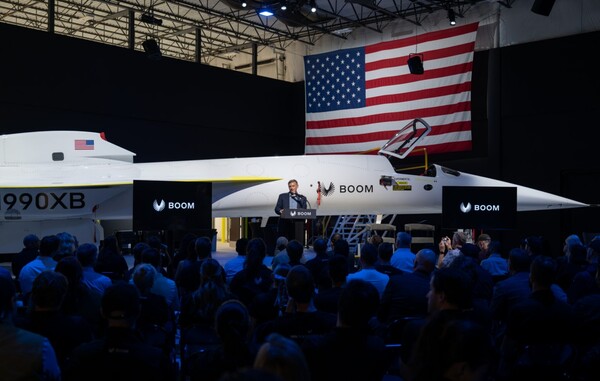
Boom Supersonic, a developer of supersonic passenger jets, is expected to face a setback to the commercialisation schedule for its Overture. The chief executive of United Airlines, a key customer, publicly pointed out that Boom's target of a first delivery in 2029 would be difficult to achieve. As Boom cultivates a gas turbine business for artificial intelligence (AI) data centres as a new growth engine, attention is focused on whether development of its core business, the supersonic passenger jet, can proceed as planned.
On Oct. 30 (local time), IT outlet Ars Technica reported that United Airlines CEO Scott Kirby said of the first delivery timing for Overture, "It will not happen in 2029" and "it will take longer."
Kirby also voiced concerns about Overture's development and the U.S. Federal Aviation Administration (FAA) certification process. He said, "There are many obstacles to overcome" and "there is no guarantee they can actually overcome them." In March this year, he had also assessed the chances of Overture entering commercial service as 50-50.
Boom has presented a goal of completing aircraft certification by 2029 and carrying its first paying passengers. It has signed conditional contracts with major airlines including American Airlines, Japan Airlines and United Airlines for the purchase of Overture. The airlines paid non-refundable deposits, but the specific amounts were not disclosed.
The institutional environment is shifting in Boom's favour. After an executive order by U.S. President Donald Trump, the FAA in June proposed new rules that would reverse regulations that have banned commercial supersonic flight over U.S. airspace. The possibility has opened that regulations that had blocked supersonic passenger jet operations in the United States could be eased.
But the foundation for actual aircraft production is still not operating sufficiently. Boom completed an Overture production plant in 2024 at Piedmont Triad International Airport in Greensboro, North Carolina, but most of the facility has since remained unused. North Carolina invested more than $50 million of public funds in the plant's construction.
Against this backdrop, Boom is expanding its gas turbine business for AI data centres. On Oct. 22, the company unveiled a production plant in Centennial, Colorado, for a 42-megawatt (MW) natural-gas turbine called Superpower. It plans to begin initial deliveries in mid-2027 and establish a production system of 25 units a year in 2028 and 50 units in 2029.
The strategy targets a trend in which natural-gas power generation facilities that can supply electricity quickly are drawing attention as power demand from AI data centres surges. Boom aims to extend technology accumulated in the aircraft engine development process into the data-centre power market.
Even so, uncertainty remains for the gas turbine business as large contracts have fallen through. Blake Scholl (블레이크 숄), Boom CEO, said via X, formerly Twitter, on Sept. 25 that a deal to supply 29 gas turbines worth $1.25 billion to data-centre developer Crusoe had been cancelled. Scholl also said Boom instead plans to supply about 250MW of Superpower at another site next year, but did not disclose specific customers.
Boom does not see Superpower for data centres and development of the Symphony engine to be installed on Overture as separate businesses. Its strategy is to develop technology that can be commonly used in both products to generate synergy between businesses. At an event unveiling the plant in October, it announced it had completed development of a turbine core prototype called Sprint Core that would be applied to both.
Sprint Core is set to undergo testing at the Colorado Air and Space Port. Boom is targeting a first ignition before Thanksgiving.
Ultimately, whether Boom's diversification can establish itself as a new growth engine will depend on actual turbine delivery results. At the same time, if Overture development and the certification schedule are also delayed, the commercialisation burden of its existing core business of supersonic passenger jets could grow. Attention is focused on whether Boom's strategy of pushing both businesses at the same time can deliver results.
 Jinju Hong
hongjj@d-today.co.kr