
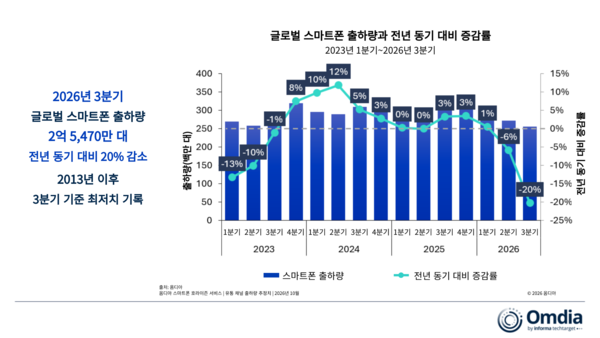
Global smartphone shipments in the third quarter fell 20 percent from a year earlier, hitting the lowest third-quarter level since 2013. Rising component costs, including memory, shrank demand in emerging markets. Samsung Electronics kept the top spot in global shipments.
Market researcher Omdia said on Nov. 2 that global smartphone shipments in the third quarter of 2026 fell 20 percent to 254.7 million units from 320.1 million a year earlier. Rising smartphone prices increased the burden on consumers, while distributors also took a cautious stance on building inventory, deepening the market contraction.
Samsung Electronics shipped 57.8 million smartphones in the third quarter to rank first globally. Shipments fell 5 percent from a year earlier, but its market share rose 4 percentage points to 23 percent from 19 percent. Entry-level and mid-range Galaxy A models remained competitive. The Galaxy Z8 series, launched in August, also supported performance in the premium market. Trade-in and device upgrade programs were assessed to have helped secure demand.
Apple shipped 56.5 million units, unchanged from a year earlier, to take second place. Its market share rose to 22 percent from 18 percent, narrowing the gap with Samsung Electronics to 1 percentage point.
Solid demand in China and North America offset weakness in emerging markets. Continued sales of the iPhone 17 series and distributors' pre-emptive inventory build-up ahead of price increases also had an impact. Apple unveiled the iPhone 18 Pro and Pro Max and the iPhone Duo in September, while pushing back the launch of the base iPhone 18 to 2027. Omdia assessed that the strategy aims to extend the sales period for the iPhone 17 and focus year-end new-product demand on premium models.
Chinese makers posted relatively larger declines in shipments. Xiaomi shipped 30.7 million units, down 29 percent from a year earlier, to keep third place. Shipments in China and India fell 20 percent and 28 percent, respectively.
Oppo, including Realme and OnePlus, shipped 23.4 million units to rank fourth, but that was down 39 percent from a year earlier. Vivo also fell 33 percent to 19.3 million units, staying in fifth place. These firms raised product prices in response to higher component costs and struggled to sell in price-sensitive emerging markets.
By region, declines in emerging markets were pronounced. Africa posted the biggest drop, with smartphone shipments down 39 percent from a year earlier. Asia-Pacific excluding Greater China, the Middle East, and Latin America also fell more than 20 percent. North America, by contrast, stayed relatively solid on demand centered on premium products and support from carrier installment financing, trade-ins and device upgrade programs.
Sanyam Chaurasia (산얌 차우라시아), a senior analyst at Omdia, said emerging markets that once led growth in global smartphone shipments are now facing the biggest pressure from rising prices. Consumers are delaying smartphone replacements or turning to refurbished products due to currency declines, inflation and higher living costs, he said.
Omdia forecast global smartphone shipments this year will fall 12 percent from a year earlier. It expects component prices to stay elevated in 2027 as supply constraints for high bandwidth memory (HBM) and commodity memory persist, keeping pressure on manufacturers' costs.
 Jin-ho Lee
jhlee26@d-today.co.kr