
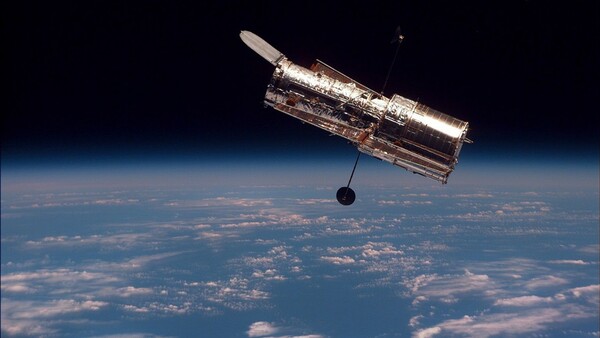
NASA is reviewing ways to use the capabilities of private space companies to extend the life of the Hubble Space Telescope, which has observed space for more than 30 years. The idea is to move Hubble to a higher altitude so it can continue its observation mission as atmospheric drag gradually lowers its orbit.
On Nov. 1, the IT outlet The Verge reported that NASA on Oct. 29 released a request for information, or RFI, on maintaining and servicing Hubble and began assessing the technical and operational capabilities of private companies. The review covers not only orbit raising but also equipment servicing and performance upgrades, and plans for safe atmospheric re-entry or disposal in orbit after the mission ends.
Launched in 1990, Hubble has far outlasted its originally expected 15-year life and continues observations. It has repaired instruments and improved performance through a total of five Space Shuttle servicing missions through 2009. But Hubble has no propulsion system of its own and cannot maintain its altitude. It gradually loses altitude because of drag from the thin atmosphere that remains in low Earth orbit.
NASA estimated that without additional measures, Hubble is likely to re-enter the atmosphere in 2033 to 2034. It also judges that any mission for orbit adjustment must be carried out by 2032. A crash is not imminent, but the situation requires preparations in advance.
Jared Isaacman (재러드 아이작먼), NASA administrator, said, "Hubble still has important science missions left," adding, "We need to look broadly for reasonable ways to extend its life." He said that if equipment already in orbit can be used longer in innovative and cost-effective ways, it is worth considering for taxpayers and the scientific community.
Nicola Fox (니키 폭스), associate administrator for NASA's Science Mission Directorate, said the private space industry is gaining new capabilities in satellite capture and on-orbit servicing and that NASA will examine various options. Hubble still plays an important scientific role, including in ultraviolet and visible-light observations.
NASA will accept industry responses until 3 p.m. Eastern time on Nov. 30. The process is aimed at examining technical feasibility, and no actual mission or contract has been finalized.
 Jae-won Choi
ittt_0801@d-today.co.kr