
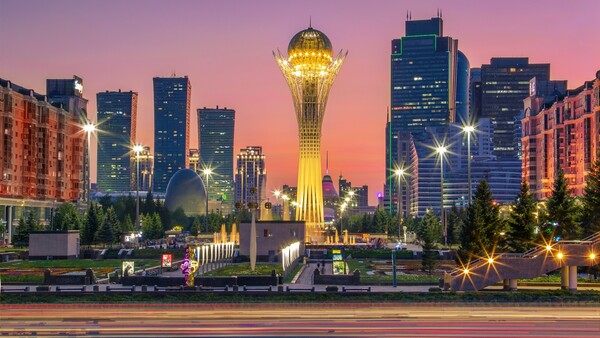
Kazakhstan is speeding up efforts to nurture its AI industry by promoting a pragmatic approach that does not tilt to either side in the technology rivalry between the United States and China. It plans to use its abundant energy resources to attract data centres and grow computing capacity into a new export industry.
On Nov. 1, the Hong Kong-based South China Morning Post reported that Kazakhstan is working to expand AI infrastructure and train specialists centred on its capital Astana. The strategy aims to shift from a traditional resource-exporting country to an AI hub in Central Asia.
Jensen Huang (젠슨 황), CEO of Nvidia, visited Astana on Oct. 23 and held a discussion with Zhaslan Madiyev (자슬란 마디예프), Kazakhstan's deputy prime minister and minister of the Ministry of Digital Development, Innovation and Aerospace Industry, on the topic of "sovereign AI". Sovereign AI refers to the concept of a country securing AI capabilities based on its own data and infrastructure. Huang compared data centres that produce digital intelligence using electricity and data to AI factories, highlighting Kazakhstan's growth potential.
Kazakhstan is also training talent. At the alem.ai International Artificial Intelligence Center in Astana, it is cultivating technical personnel through Tomorrow School, a free coding and AI education institution, and Tumo Astana, a digital creation education facility for youths. Astana Hub, a base for supporting startups, also helps local technology companies grow.
The U.S.-China technology competition is also reflected across local industry. On Astana streets, Chinese car brands such as BYD and Changan are becoming more visible, while U.S. chip technology from Nvidia plays a key role in building AI infrastructure. Kazakhstan aims to use the strengths of both countries to build an independent technology ecosystem.
The key is sustainability. Data centres can be expanded through investment and securing electricity, but it takes a long time to build a foundation that steadily produces top talent and innovative companies. Expanding AI infrastructure does not automatically lead to technological self-reliance. Attention is focused on whether energy-rich Kazakhstan can transform into an exporter of AI technology.
 Choi Jae-won
ittt_0801@d-today.co.kr