
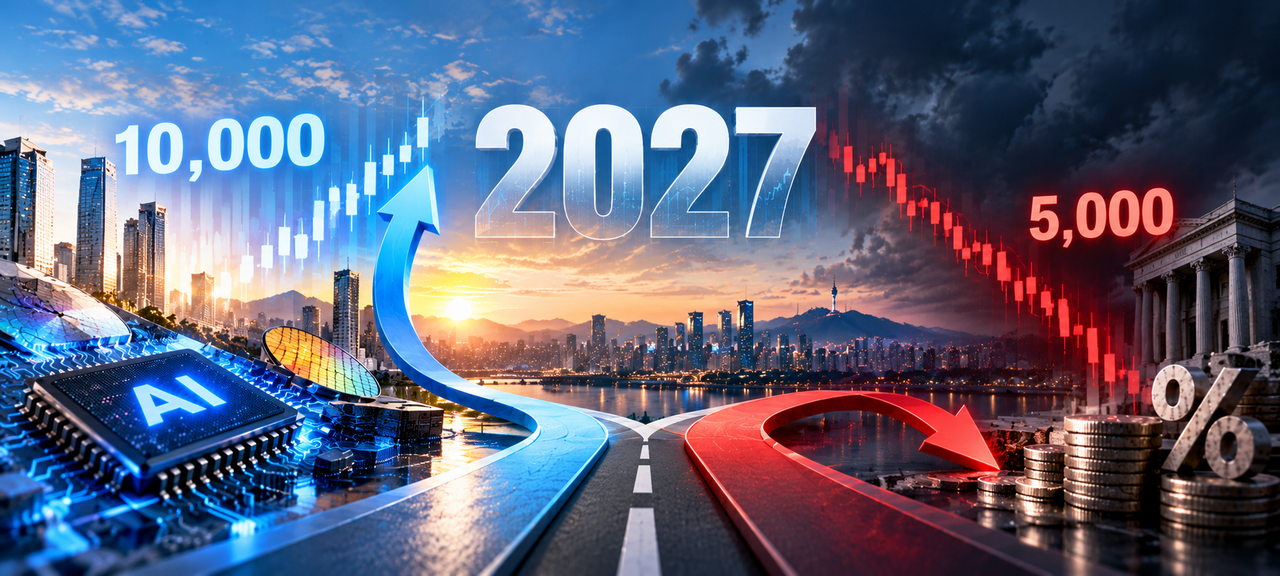
Views among brokerages on South Korea's stock market next year are diverging. They share expectations for improving semiconductor earnings and expanded shareholder returns, but KOSPI forecasts range from 5,000 to 10,000 depending on assessments of high interest rates, an economic slowdown and the sustainability of artificial intelligence (AI) investment.
According to the financial investment industry on Nov. 2, brokerages' forecast ranges for next year's KOSPI were compiled as follows: Shinhan Securities 5,000 to 8,000; Kiwoom Securities 5,100 to 8,100; Daishin Securities 5,200 to 8,200; Hana Securities 5,250 to 8,500; Hanwha Investment & Securities 6,000 to 9,300; and Yuanta Securities 6,000 to 10,000.
Yuanta Securities offered the most optimistic view. Kim Yong-gu (김용구), an analyst at Yuanta Securities, expected the KOSPI to show a pattern of being weaker in the first half and stronger in the second half, and to challenge the 10,000 level. He judged that earnings growth at AI and semiconductor companies could be joined by improved foreign buying and corporate value re-ratings.
He also forecast the quarterly range would rise gradually from 6,000 to 7,500 in the first quarter, to 6,500 to 8,000 in the second quarter, 7,500 to 9,000 in the third quarter, and 8,500 to 10,000 in the fourth quarter. Under a best-case scenario in which expanded AI investment and foreign inflows are stronger than expected, he left open the possibility of a rise to the 12,000 level.
Hanwha Investment & Securities also put more weight on a weaker first half and stronger second half. It presented a 2027 KOSPI target of 8,500 and an expected range of 6,000 to 9,300. Earnings growth at semiconductor companies and improved return on equity (ROE) were cited as the basis for a stock price rise.
Hana Securities presented a KOSPI range of 5,250 to 8,500. It analysed the market as undervalued, citing a 2027 KOSPI net profit forecast of 105.6 trillion won and a 12-month forward price-to-earnings ratio (PER) of only 4.6 times.
Lee Jae-man (이재만), an analyst at Hana Securities, forecast that Samsung Electronics and SK Hynix would lead a rebound from the end of this year through the first quarter of next year. He focused on the possibility that market leadership could shift as a semiconductor-led rise spreads to other sectors.
Daishin Securities, by contrast, presented a 2027 KOSPI range of 5,200 to 8,200 and expected a pattern of being strong in the first half and weaker in the second half, with the rise losing momentum later in the year after a first-half rebound.
It analysed that in the first half, stabilising inflation and interest rates could restore confidence in corporate earnings, but in the second half, accumulated high-rate burdens and rising raw material prices could pressure the economy. It said the market's direction would differ depending on whether expanding investment by AI-related companies translates into actual profits.
Kiwoom Securities presented a relatively conservative range of 5,100 to 8,100. It judged that although strong semiconductor conditions significantly improved profitability at domestic companies, the current high level of earnings would be difficult to sustain for a long period.
Han Ji-young (한지영), an analyst at Kiwoom Securities, analysed that with the sharp profit surge from an exceptional semiconductor boom already reflected in current stock prices, it will be important next year whether elevated earnings can actually be maintained.
She expected volatility could persist in the first half due to concerns over U.S. long-term interest rates and the profitability of AI investment, but uncertainty would gradually ease after the second quarter.
Shinhan Securities, offering the most cautious outlook, presented an annual 2027 KOSPI range of 5,000 to 8,000 and a fair index level of 7,000 at year-end.
Noh Dong-gil (노동길), an analyst at Shinhan Securities, stressed that semiconductor profit growth and corporate value re-ratings should be viewed separately. He said that even if semiconductor companies' results improve, it could be difficult for them to receive valuations as high as in the past.
He forecast that next year's market will increasingly depend not only on corporate profit growth but also on the accumulation of book value per share (BPS) and actual improvements in profitability.
With index forecasts diverging by brokerage, differences also emerged in sector-by-sector investment strategies. Semiconductors were commonly cited as a key variable for next year's market, but the leading sector could change as the year moves into the second half.
Hanwha Investment & Securities forecast that semiconductors and IT hardware would lead gains through the first quarter of next year. From the second quarter, it expected gains to spread to banks, steel, transport and utilities as upward pressure on interest rates eases and the won strengthens.
Hana Securities highlighted secondary batteries and IT hardware in the first half, and pharmaceuticals and biotech and autos in the second half. It analysed that LG Energy Solution and Samsung Electro-Mechanics could compete for the No. 3 spot by market capitalisation in the first half, and Samsung Biologics and Hyundai Motor could draw attention in the second half.
Daishin Securities said that as earnings improvements centred on semiconductors continue, investment opportunities could expand to other sectors such as defence, finance and shipbuilding. It expected sector differentiation to deepen in the second half as an economic slowdown and high-rate burdens could expand.
Another view was that investor interest could shift from KOSPI large caps to KOSDAQ and small- and mid-cap shares.
Kang Hyun-gi (강현기), an analyst at DB Securities, analysed that the KOSDAQ could show relative strength as supply and demand concentrated in large semiconductor shares eases. He also cited as positive factors that the KOSDAQ formed a bottom before the KOSPI and government policies to revitalise the market.
DB Securities forecast that in the first half of next year, the KOSDAQ could rise led by individual stocks, and in the second half, the long-neglected healthcare sector could draw attention. It also judged that the KOSPI's valuation has fallen sharply compared with past averages, which could limit room for further declines.
Uncertainty surrounding the AI industry still remains. As competition among AI companies intensifies, service fees are falling, while infrastructure investment costs, including data centres and semiconductors, are rising. With higher interest rates adding to funding burdens, questions are also being raised about profitability at related companies.
In the end, key variables for next year's market are how much the high profit growth rate of semiconductor companies can be maintained and whether expanded AI investment translates into actual profits. Depending on interest rates and the economic cycle, market leadership could shift from large semiconductor shares to small- and mid-caps, cyclicals or defensive stocks.
Kang said, "Alternative investment destinations could emerge in the stock market," adding, "Interest in small- and mid-cap shares centred on the KOSDAQ could appear."
 Oh Sang-yup
yub@d-today.co.kr