
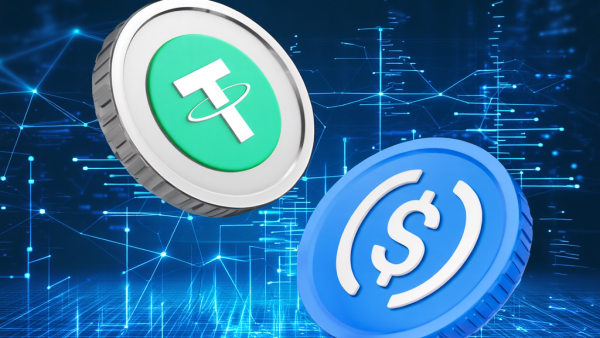
In euro-based stablecoin trading, Circle's USDC has overtaken Tether's USDT.
On Oct. 27, blockchain media outlet Cointelegraph reported that the trading structure in the euro market is changing rapidly as major exchanges restrict USDT trading for European Economic Area (EEA) customers to comply with the European Union's crypto regulation MiCA.
According to Kaiko data, USDC's share of euro stablecoin trading rose to 56 percent recently from 10 percent in January 2024. As trading restrictions on some stablecoins expand for EEA users, trading funds have shifted to products that meet regulatory requirements.
Order book depth for USDC traded in euros was about 40 percent thicker than for USDT. That means more buy and sell orders are stacked, which is advantageous for reducing price swings from large transactions. Global circulation, however, is still about 2.5 times larger for USDT than for USDC.
Kaiko saw stablecoin-euro trading pairs as a key channel for European investors to enter the market and withdraw funds. The rise in USDC's share in this market shows that the means European users use to put in and take out funds is changing.
Amid the shift, oversight of USDC is also being tightened. The European Banking Authority (EBA) on Oct. 14 designated USDC as the first "significant e-money token" under MiCA. From Nov. 12, supervisory authority in some areas, including capital, reserve assets and liquidity, will be transferred from France's Prudential Supervision and Resolution Authority (ACPR) to the EBA, and additional regulatory requirements will apply to the issuer.
In the United States, compliance is also emerging as a variable in stablecoin competition. Kaiko said the United States is preparing a regulatory framework similar to Europe's through the GENIUS Act, and it saw the possibility that trading on U.S. exchanges could also shift to products that meet regulations. The Office of the Comptroller of the Currency (OCC) on Oct. 21 announced final rules covering issuers under supervision, including reserve and redemption requirements. The effective date is Jan. 18, 2027.
From July 2028, providing or selling stablecoins to U.S. users that fail to meet statutory approval requirements or requirements related to foreign issuers will also be restricted. That means products handled by exchanges and the flow of trading funds could change depending on how issuers respond to regulation.
Issuers also differ in how they respond. Circle has pursued a strategy to meet regulatory requirements in Europe and the United States. Tether has launched a separate stablecoin, USAT, aimed at the U.S. market, with Anchorage Digital Bank responsible for the actual issuance. If the trading shift seen in Europe is repeated in the United States, not only issuance scale but also regulatory compliance and availability on exchanges are likely to shape the battle for market share.
 Yoonseo Lee
yslee@d-today.co.kr