
Oracle is moving faster to expand the role of its core database (DB) platform as it seeks to increase its stake in the AI agent era.
Techzine reported that Oracle is fleshing out a strategy to advance its database beyond a system of record for storing records into a “system of outcomes” where agents can deliver higher-grade business results.
That push targeting AI agents was also highlighted at Oracle’s annual AIWorld 2026 conference now under way in Las Vegas on Oct. 26 local time.
At the event, Oracle’s strategy was summed up as putting the database at the center and deploying Fusion Cloud to manage AI agents that can handle higher-order tasks on top of it. The company appears to be seeking to build a system in which AI agents manage work around the database.
Fusion Cloud supports companies in developing and operating AI agents that automate enterprise resource planning (ERP), finance and supply chain management tasks across Oracle Cloud Infrastructure (OCI)-based Fusion applications. It connects with the latest AI models from Google and OpenAI.
On Fusion Cloud, Oracle stresses that it provides AI agents that can clearly deliver business outcomes.
According to Techzine, Oracle currently provides 25 prebuilt agentic applications across Oracle Fusion Cloud ERP, HCM, SCM and CX. They include applications that support searching for job candidates, payroll management, delivery schedule coordination and measuring in-house customer service quality.
In addition to its prebuilt agents, Oracle plans to actively support customers and partners in developing their own agentic applications tailored to Fusion applications. Oracle provides these agents with execution-status monitoring, return-on-investment (ROI) metrics and security controls.
Oracle’s moves are part of an effort to provide AI agents that work properly in real-world use. Oracle released a public Git repository called “FSCR” that organizes Fusion configuration methods so AI agents can read and execute them, making it easier for companies to run AI agents in production. Enterprise AI assistants and coding agents from OpenAI and others can use FSCR to turn business requirements, process documents and existing configurations into implementation instructions.
Based on this, it carries out configuration directly in Fusion and automatically tests and validates results. Experts review the final results before applying them to a live environment. Partners including Accenture Edge, Deloitte and PwC can also add their own methodologies, development acceleration tools and industry-specific solutions to FSCR.
Fusion Cloud can be used only within Oracle products. Because it depends on Fusion applications and OCI, companies that have already invested heavily in Oracle may welcome stronger management and cost-saving effects, but it has also been pointed out that it could be a burden for companies that use multiple vendors together.
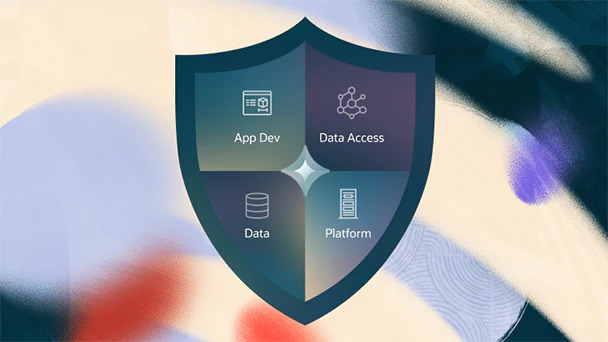
Oracle’s “Deep Trust AI Architecture” announcement is also drawing attention.
The Deep Trust Architecture focuses on embedding safeguards across Oracle AI Database, Oracle Autonomous AI Database and the low-code app development platform Oracle APEX AI Application Generator.
It supports applying security, privacy and business rules and generating trusted applications. The structure allows control within the product, from data use and app development to access rights and automatic updates.
The company said that as enterprises deploy more AI agents and AI-generated applications into existing architectures, tasks have emerged including protecting sensitive information, applying business rules, ensuring accurate answers to business-related questions and maintaining control over interactions between AI and enterprise systems.
There are limits if access or work rules are implemented only in apps. For AI-made apps, incorrect rules can be inserted, and agents integrated into the DB can even bypass rules entirely. With this in mind, Oracle stresses that it implemented rules inside the DB through Deep Data Security. With Deep Data Security, if enterprises define in the DB who can see what data, the DB can check the list with each request and provide only permitted data.
At this point, it is not yet clear how Oracle will check and verify what agents did. When Oracle unveiled Fusion Cloud in September, it mentioned an “Outcome Receipt” for each execution, but at this event it put more weight on observability and approvals, Techzine reported.
Oracle also plans to roll out within the next 12 months a business semantic layer that helps agents understand work context, and an AI data catalog that lets users search and use dispersed data in one place without moving it.
Juan Loaiza (후안 로이자), Oracle’s senior vice president in charge of AI database technology, said, “AI models now enable productivity improvements and innovation at an astonishing level. But if a company cannot trust the results generated by AI, it cannot realize these benefits. Trust in AI is the biggest challenge we face today.” He added, “With Oracle Deep Trust AI Architecture, we are embedding trust into the foundational software platform, data, data access and application development layers. This allows enterprises to use AI while maintaining control over what information AI agents and AI-generated applications can access and what actions they can perform.”
 Chi-gyu Hwang
delight@d-today.co.kr