
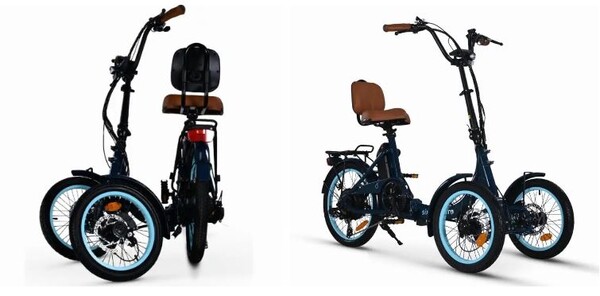
Folding electric bikes are useful for storing in tight spaces and can be loaded into vehicles, but they do not necessarily guarantee real portability or riding convenience. Buyers need to weigh everything from the burden of motor and battery weight to ride comfort, range, price and maintenance to avoid regrets.
On Oct. 26, IT media outlet Engadget pointed out that buyers of folding electric bikes should review overall factors such as weight and ride comfort, battery capacity, price and the burden of maintenance.
The first thing to check is weight. Folding electric bikes typically carry a motor and battery, and also need hinges and locks to create a folding structure. They can reduce storage space, but that does not mean the burden of lifting and carrying the bike is reduced as well.
A representative case is electric bike maker Lectric's folding model XP4. It has a 500-watt motor and weighs about 28 kg excluding the battery. Adding a roughly 3.2 kg battery brings total weight to about 31 kg. That can be a significant burden when loading it into a vehicle or going up and down stairs. Even if the battery can be removed, portability is limited if the main unit is heavy.
How it folds also matters. Buyers need to check whether the frame can be held securely when folded and whether the locking mechanism stays properly fastened while moving. Some products can be pulled along when folded, but not every model is designed the same way. If using public transport, buyers should also check carriage rules. Amtrak limits electric bike weight to 50 pounds, which can restrict use of heavier models.
Ride comfort is also something to inspect before buying. Folding electric bikes often use small wheels to reduce size. That helps for indoor storage or moving through tight spaces, but bumps can be transmitted more strongly on uneven roads. If you often ride over potholes or damaged roads, it is better to look at wheel size, tire width and whether there is suspension.
Buyers should also check whether the saddle and riding posture fit their body. A folding structure does not itself mean an uncomfortable ride, but riding convenience can vary depending on saddle height and position and handlebar height and reach. If you plan to use it for long-distance commuting, it is more helpful to test-ride it in conditions similar to the actual riding environment than to decide after only a short trial.
Performance needs also vary by purpose. A compact model may suit short trips on flat roads, but longer commutes or rough-road riding may be better served by a product with bigger wheels and a more stable ride. Before buying, riders should check steering and braking themselves and see whether it feels comfortable on the road conditions they normally use.
Battery capacity and real-world range should also be considered. Being a folding model does not necessarily mean lower power or shorter range, but battery capacity can be limited in the process of reducing the frame's size and weight. Lectric notes that the XP4's range can vary depending on load, terrain and weather. That means range can shrink if you carry a lot, face frequent hills or ride on poor road surfaces. The maximum range presented by a manufacturer should be taken as an estimate that can change with real usage conditions.
Price is also a burden factor. High-end folding electric bikes can cost thousands of dollars. Brompton's electric bike lineup starts at $4,700 for the Electric C Line, $5,500 for the Electric P Line, and the Electric T Line reaches $7,850. Even so, a higher price does not necessarily mean it is lighter or has longer range. Buyers should compare based on the functions they actually need, such as weight, battery performance and how it is carried.
Maintenance and parts supply are also easy to miss. Beyond checking basic components such as tires, brakes and chains, buyers should also look at hinges and locks where loads concentrate during repeated folding and unfolding. Bike maker Tern recommends regular checks of joints in folding structures and confirming their condition before riding. That is because misadjusted or damaged joints can affect safety.
Buyers should also confirm at the purchase stage whether the battery and dedicated parts can be replaced. As batteries are consumable parts whose performance declines over time, it is necessary to check whether replacement batteries can be supplied on an ongoing basis. The availability of parts that apply only to specific models, such as folding joints or locking mechanisms, also affects long-term maintenance costs.
Folding electric bikes can reduce storage space and increase the usefulness of a means of transport, but buyers should not assume they are easy to carry simply because they fold. Before buying, it is necessary to check whether the weight can actually be lifted and carried, whether it suits your riding environment and body, and whether battery replacement and maintenance are possible.
 Jinju Hong
hongjj@d-today.co.kr