
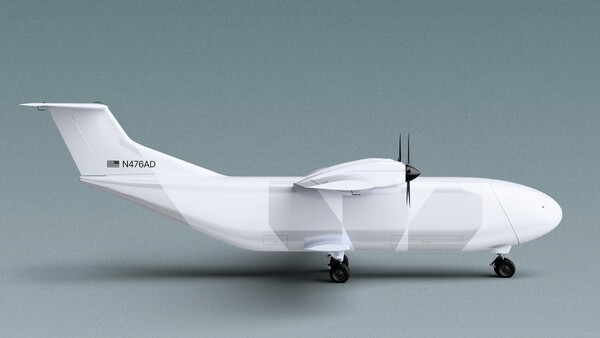
A large autonomous drone capable of transporting up to 1.8 tonnes of cargo without a cockpit is being developed in the United States. The plan is to remove space for a pilot to improve loading efficiency and cut air cargo transport costs.
TechRadar, an IT media outlet, reported on Oct. 27 local time that U.S. aviation startup Poseidon Aerospace is developing the Egret unmanned freighter with a 50-foot wingspan, about 15.2 metres, and a maximum payload of 4,000 pounds, about 1,814 kg.
Egret focused on unmanned cargo transport from the design stage rather than modifying an existing manned aircraft. It reduced airframe weight and maximised cargo space by removing the cockpit and pilot life-support systems.
Development is being led by David Zagaynov (데이비드 자가이노프), who previously worked in Amazon's logistics division, and Parker Tenney (파커 테니), an engineer formerly at Lockheed Martin. Zagaynov compared Egret to a self-driving truck that flies and explained, "The goal is to transport cargo to its destination as cheaply as possible."
Even without a pilot onboard, that does not mean fully autonomous flight. In the early testing phase, a remote pilot at a ground control centre can watch live camera footage while controlling engine thrust, flaps and the rudder.
Poseidon earlier succeeded in test flights of the V0 prototype after multiple design changes. It then built Seagull, a quarter-scale test aircraft of Heron, which is being developed for water operations. Seagull uses a carbon-fibre structure and was also used in demonstrations for military-related organisations.
Egret's first unmanned test flight is scheduled to take place in Oregon by the end of this year. The company plans to use it to verify flight control and communications stability.
Poseidon recently raised $60 million in a Series A funding round led by TQ Ventures. The funds will be used for test flights, building a production line and expanding commercial and military logistics businesses.
According to the design disclosed by the company, Egret has a maximum cruise speed of 160 knots, about 296 km per hour, and a range of at least 1,650 nautical miles, about 3,055 km. Its actual flight performance, fuel consumption and transport costs have not yet been verified, so its commercial competitiveness will depend on future test results.
 Jae-won Choi
ittt_0801@d-today.co.kr